Case Study: Maintenance Failure at a Chicago Food Packaging Facility
The importance of filtration is often underestimated – that is, until equipment failure makes its role impossible to ignore. Whether it’s a furnace filter in a home HVAC system, an automotive air filter or a clogged shop vacuum, many users delay replacement well beyond the intended service life. At home, a delay may result in higher utility bills or reduced comfort. In an industrial environment, the consequences are more serious. Filtration directly influences equipment reliability, plant productivity and energy consumption.
Industrial filters are more than accessories. They are protective devices engineered to safeguard capital equipment and preserve operational performance. Whether installed on dust collectors, industrial blowers, air compressors, vacuum pumps or other process-specific systems, filtration protects both machinery and margins. When filters become overloaded or clogged, they introduce resistance in the form of pressure drop. That restriction limits airflow, degrades performance and increases energy consumption for certain types of rotating equipment. What may appear to be a minor increase in restriction can quietly translate into thousands or even tens of thousands of dollars in lost productivity and higher electricity costs each year.
In severe cases, neglected filters can bypass or fail catastrophically, allowing contaminants to travel downstream into critical equipment. The result can include emergency service calls, unplanned downtime, product contamination and major mechanical repairs. In nearly every case, those costs far exceed the expense of routine filter maintenance.
.jpeg)
In severe cases, neglected filters can bypass or fail catastrophically.
This article examines how industrial facilities can quantify the return on investment associated with disciplined filter change scheduling. By connecting pressure drop, energy consumption, maintenance costs and equipment longevity, facilities can move from reactive maintenance to measurable operational control.
The Value of Industrial Filtration for Rotating Equipment
Industrial filtration systems play a central role in protecting and sustaining rotating equipment. Filters serve as the first barrier against airborne or process-generated contaminants. These contaminants may include fine powders, abrasive particulate, fibers, metal shavings and aerosols. While many are microscopic, their cumulative effect is not. Wear accelerates, clearances change, efficiency declines and equipment life shortens.
Effective filtration is about achieving and sustaining equipment performance. Proper filtration reduces maintenance costs, stabilizes airflow or vacuum levels and extends the usable life of high-value equipment. In industries such as food and beverage, pharmaceutical processing, chemical production, bulk material handling and packaging, even minor deviations in airflow stability can disrupt throughput and compromise product integrity. Filtration is therefore an operational control component, rather than a maintenance afterthought.
At the center of filtration performance is the concept of pressure drop, which deserves more attention than it typically receives.
Pressure Drop and Differential Pressure
Pressure drop, also referred to as pressure differential, is the reduction in pressure occurring when a fluid passes through a restriction point in a system. In filtration applications, restrictions may include piping, valves, fittings and the filter itself. For this discussion, the focus is on the filter element.
A filter element is engineered to capture particulate while allowing clean air or gas to move downstream. However, every filtration system involves a trade-off. As contaminants accumulate on the media surface and within its depth, resistance increases. The system must work harder to maintain the required flow. That added resistance appears as rising pressure drop across the element.
When a filter is new, resistance is at its lowest. This is known as the clean or initial pressure drop. Manufacturers carefully design filter surface area, pleat geometry, fiber density and pore structure to balance contaminant capture efficiency with acceptable airflow resistance. As the element loads, airflow pathways constrict. Effective open area decreases. Resistance rises.
Differential pressure is measured as the upstream pressure minus the downstream pressure and is commonly expressed in inches of water column in air systems.
Consider an industrial blower operating at 500 cubic feet per minute (cfm). With a clean inlet filter, pressure drop may measure 1 to 2 inches of water column. After several weeks in a dusty environment, the value may rise significantly. If ignored, it may climb to 20 or 25 inches of water column. The numbers may appear small, but the operational impact is not.
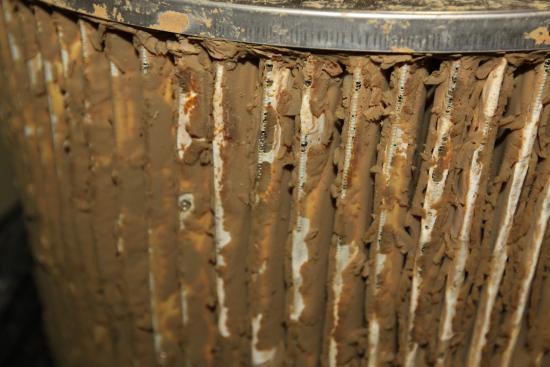
As the filter element fills with contaminants, airflow pathways constrict, effective open area decreases and resistance rises.
Pressure Drop, Energy Consumption and Heat Generation
Rotating equipment is selected to operate within defined airflow, pressure and load parameters. Industrial blowers, air compressors and vacuum pumps are selected based on expected system resistance, including the contribution from filtration. When actual resistance exceeds design assumptions, performance shifts.
As restriction increases, mechanical load increases and energy consumption rises as motors draw more current to sustain airflow. For certain equipment types, elevated inlet restriction can reduce delivered flow while simultaneously increasing power demand. Oil mist filters on the discharge of oil-lubricated pumps and air compressors have a similar impact on performance and power consumption as they clog.
Even modest increases in pressure drop can generate measurable energy penalties. A moderate rise in restriction may increase motor load by several percentage points. In systems that operate thousands of hours per year, that incremental load becomes a recurring energy expense. Across multiple motors in a facility, the compounded effect is significant.
Increased load also generates additional heat. Elevated operating temperatures accelerate wear on bearings, windings and seals. In pressure and vacuum applications, inconsistent airflow and pressure levels can degrade process consistency and reduce throughput. What begins as a loaded filter can ultimately shorten equipment life and erode operational reliability.
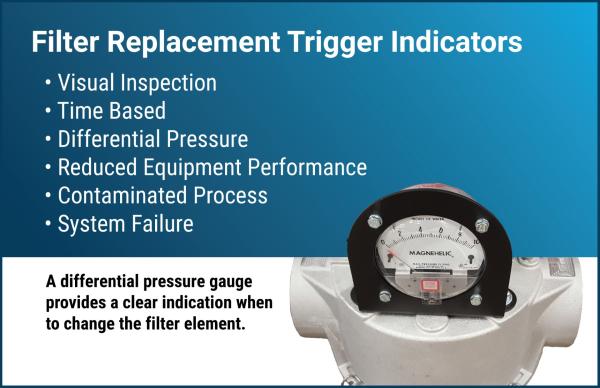
Facility managers who want to control these risks must move beyond visual inspection. A defined filter change plan based on measured differential pressure establishes a clear maintenance threshold. Monitoring restriction and replacing filters before excessive loading occurs preserves system efficiency, protects capital equipment and reduces the likelihood of unscheduled downtime.
Case Study: Maintenance Failure at a Chicago Food Packaging Facility
A modern food packaging facility in the Chicagoland area provides a clear example of how quickly pressure drop can escalate into operational and financial disruption. The plant relied on multiple 20 horsepower (hp) side channel blowers to provide stable vacuum for product conveying and automated form, fill and seal operations. Under normal conditions, with clean inlet filtration, each industrial blower operated at slightly under 15 brake horsepower (bhp) or roughly 11 kilowatts (kW). At that load, each blower delivered optimal vacuum and airflow required to keep production stable across multiple packaging lines.
Over a six-month operating period in normal operating conditions, the inlet filters loaded with dust and debris. As restriction increased, differential pressure climbed from roughly 2 inches of water column at startup to more than 40 inches at failure. That increase contributed an additional 5 hp load to each blower motor. Instead of operating near 15 bhp, the units were pushed beyond full load amperage, reaching nearly 20 bhp or 15 kW.
The facility contacted its equipment supplier in a state of extreme urgency, reporting several industrial blowers had seized. Upon inspection, the equipment showed visible discoloration consistent with overheating. The inlet vacuum filters were subsequently inspected and found to be completely clogged with dust and debris. The excessive differential pressure forced the blowers to operate beyond their design limits, resulting in elevated temperatures, bearing failures and, in one case, catastrophic mechanical damage.
Multiple industrial blowers failed. Two units were salvageable with bearing replacement. Each repair required approximately 2.5 labor hours plus \$200 in replacement parts per blower at a total cost of approximately \$395 per unit. The repairs also required equipment removal, disassembly and reinstallation, resulting in production downtime.
The third industrial blower was beyond repair. A complete replacement unit, priced at \$15,000, had to be air freighted into the facility at a shipping cost of approximately \$1,500. Installation required eight labor hours. The total cost of replacement was approximately \$17,500. The direct repair and replacement costs were significant, however the indirect costs were far greater.
The failure shut down the packaging operations for two full days. The plant operated two shifts totaling 16 production hours per day, resulting in 32 hours of lost runtime. The estimated cost of downtime was approximately \$3,000 per hour and production losses alone approached \$96,000.
Beyond the measurable financial impact, the disruption created backlog, customer shipment delays, idle labor and overtime expenses required to recover production. Customer confidence was strained. The entire event was triggered by neglected inlet filtration.
This maintenance failure could have been avoided. The pressure drop change was gradual and went unnoticed until the industrial blower equipment failed. The recommended filter changeout is approximately 15-20 inches above initial pressure drop, which occurred somewhere around the three-month mark. The replacement cost of each filter element was \$96. Changing a filter requires approximately 0.5 labor hours per blower. Even including labor, had the filter change occurred at the three-month time frame, the preventive maintenance cost would have been insignificant compared to the six-figure operational impact.
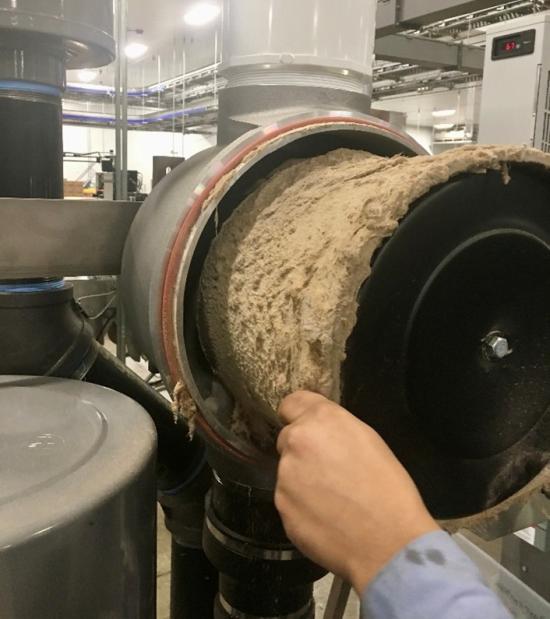
Filter neglect at a Chicago food packaging facility led to significant replacement costs and hours of downtime.
Energy Consumption and Preventable Cost
To understand the energy penalty, consider the incremental load increase experienced at the Chicago packaging facility. With a 2.5 bhp or 1.87 kW increase due to pressure drop, at \$0.12 per kW, the cost to run an industrial blower for three months at 16 hours per day increases by roughly \$320. In this case, it is still more cost-effective to change the filter and maintain a lower pressure drop with lower energy consumption. This example illustrates a fundamental principle. Pressure drop is not merely a number on a gauge. It is a measurable indicator of energy consumption, equipment stress and operational risk.
When facilities establish a defined differential pressure threshold and replace filters before excessive loading occurs, they control energy costs, preserve equipment life and protect production continuity. When they ignore it, the consequences compound quickly. Filtration is not a consumable expense to be delayed. It is an operational control strategy that directly influences reliability, efficiency and profitability.
The Value of Proactive Filter Maintenance
When a replacement filter costs only a few hundred dollars, the payback period is rarely measured in months. In many continuous duty applications, the energy savings associated with reducing pressure drop can offset the cost of a new filter within a short operating window. The financial logic is straightforward. Lower restrictions reduce motor load. Reduced motor load lowers energy consumption. Over time, the savings accumulate quickly.
Postponing filter maintenance doesn’t reduce costs. It merely redirects them. Instead of appearing as a modest maintenance expense, it shows up as elevated energy consumption and accelerated mechanical wear. The system continues to operate, but it does so less efficiently and under greater strain. That strain is cumulative. Bearings experience higher temperatures. Motors overheat and burn out. Rotating components work harder to maintain flow and target pressure. Each additional hour of operation under elevated restriction incrementally shortens component life.
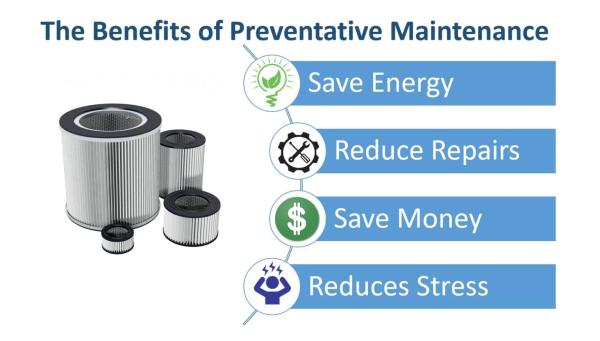
Proactive filter maintenance is more than a scheduled task on a checklist. It is a strategic decision protecting capital equipment, stabilizing energy consumption and preventing minor inefficiencies from escalating into measurable financial loss. When facilities monitor differential pressure and act before excessive loading occurs, they maintain control of both operating cost and reliability.
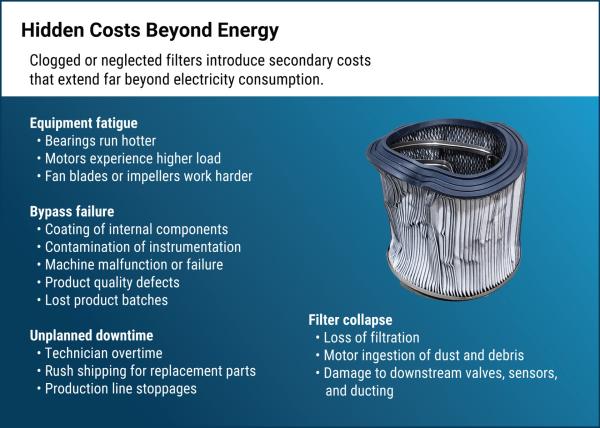
Hidden Costs Beyond Energy
The financial impact of neglected filtration extends beyond energy use. Clogged or overloaded filters introduce secondary effects often not captured in a simple energy calculation. Elevated restriction increases heat within the motor and bearing assemblies, accelerating fatigue and reducing service life. Rotating components operate under greater load to sustain airflow, increasing stress on shafts and couplings. In severe cases, excessive loading contributes to filter collapse, allowing unfiltered contaminants to pass downstream.
Once bypass or structural failure occurs, the consequences multiply. Dust and debris may enter the equipment or process stream. Internal components can become coated with particulate, degrading balance and airflow characteristics. Additionally, sensors and instrumentation may become contaminated, leading to inaccurate readings or system malfunction.
Operational disruption often follows. Production lines may slow or stop. Technicians are called in for emergency repairs. Overtime labor is required. Replacement parts are expedited at premium freight rates. In certain industries, product contamination may result in scrapped batches or compromised quality. What begins as a neglected filter can cascade into equipment damage, production loss and customer dissatisfaction. The cost of prevention remains small. The cost of inaction rarely is.
Conclusion: Filtration as an Operational Strategy
In industrial environments where uptime, efficiency and product quality define competitiveness, filtration should be managed with the same discipline applied to any other critical operating parameter.
Pressure drop and energy consumption are measurable. Equipment wear is predictable. When differential pressure rises beyond recommended limits, the consequences are real. They show up in increased kilowatt hours, elevated temperatures, shortened equipment life, reduced performance and, in extreme cases, catastrophic failure.
The Chicago packaging facility demonstrates how quickly a neglected maintenance item can escalate into a six-figure expense. The direct repair costs were significant, however the production losses were far greater. The root cause was not a design flaw or an unpredictable failure mode. It was excessive inlet restriction going unaddressed.
Facilities treating filtration strategically gain control over performance and cost. Establishing a defined pressure threshold, monitoring restriction routinely and replacing filters before excessive loading occurs transforms maintenance from reactive to preventative. Energy consumption stabilizes. Equipment life extends. Production reliability improves.
About the Authors

Bella Alfaro serves as Marketing Coordinator at Solberg Manufacturing, contributing to technical content strategy and market communications within industrial filtration. She collaborates with cross-functional teams to ensure accuracy while translating complex system processes into practical insights for customers. She holds an MBA and focuses on aligning market needs with engineered solutions.

Rich Ricciardi is the Plastics Industry Market Manager for Solberg Manufacturing. He brings nearly two decades of filtration expertise, complemented by extensive technical knowledge developed over a 12-year tenure as a Sales Engineer for a leading vacuum pump and blower OEM. This background has provided him with a comprehensive understanding of vacuum and air-handling technologies and their wide-ranging industrial applications.
About Solberg Manufacturing
As an international market leader in filtration, separation and silencing, award-winning Solberg Manufacturing, based in Itasca, IL, is recognized as a trusted partner to its customers, colleagues and suppliers. Its diverse and effective filtration solutions play a role in operations around the globe. Solberg believes that having the proper filtration and separation technology is essential for any business operating rotating equipment.
For more information, visit https://www.solbergmfg.com.
For similar Rough Vacuum Systems articles, visit https://www.blowervacuumbestpractices.com/technology/rough-vac.
Visit our Webinar Archives to listen to expert presentations on Rough Vacuum Systems at https://www.blowervacuumbestpractices.com/magazine/webinars.