Industrial Utility Efficiency

System Assessments

As the Best Practices Magazines celebrate their twentieth anniversary, we wanted to take a moment to reflect on the remarkable system efficiency gains achieved since our first issue. We also wanted to give subscribers a peek at what the next decades might bring. To do this, we asked a hand-selected list of original equipment manufacturers, independent compressed air system sales and service companies, manufacturing plants and independent system auditors to share their thoughts, highlighting the changes they’ve seen over the past 20 years, then predicting what the next 20 years will bring.

APG-Neuros Aeration Blowers Treat Industrial Wastewater

Different industries have differing levels of toxins and contaminants that need to be reduced before wastewater can be discharged. The company specializes in understanding those requirements and creating custom turbo blowers to customer specifications. Its leading industries are pulp and paper, poultry and food and beverage. 

Dual Point Aeration Blower Control

Historically, the most common dual point control has been combining inlet guide vanes and variable discharge diffuser vanes. These are both mechanical systems and predate the availability of economical variable speed control. Recent advances in power electronics technology and improved VFD economics have led to implementing other combinations for dual point control. These include combining VFD control with either VDVs or IGVs.

Advanced Aeration Control for Blowers

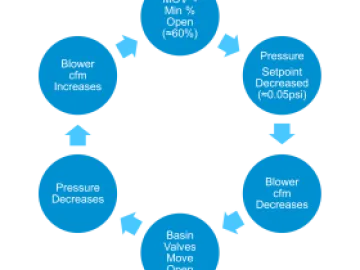
The ideal blower control matches the blower airflow to the process demand. The process demand, in turn, must be established by the aeration control system. This control strategy has become standard practice in most treatment facilities because of its proven effectiveness in reducing energy consumption and improving process stability.

7 Best Practices for Leak Detection in Vacuum Systems

Leaks in vacuum systems can cause considerable damage to sensitive industrial processes. The vacuum pump’s ability to generate and maintain the desired vacuum level is compromised as the process gas escapes the pump or contaminants – such as air, dust and debris – enter. This leads to accelerated wear and tear of internal components such as seals and gaskets, and the vacuum pump may fail or require more frequent servicing. As a result, energy bills and overall operating costs increase drastically, while output quality suffers. 

Centralized vs. Point of Use Vacuum Filtration

In this article, we will isolate and review one system common to many plants and industries: the vacuum system. Within this system, we will further drill down to the filtration required to maintain a healthy process, which contributes directly to the bottom line. The vacuum system does not exist in many production process lines without filtration. Throughput and quality of the end product are closely tied to the necessary vacuum levels achieved when filtration is properly deployed.

pdblowers Soars in Aerospace Vacuum System Installation

The aerospace division of a large industrial manufacturer, uses a large altitude simulation chamber to test aircraft parts at different atmospheric conditions. It was based on this application, that the pdblowers team created what the facility needed: a multi-stage vacuum system that could manage varying mass flows at different vacuum levels.
 

Six Summer Maintenance Tips for Your Vacuum Pump

By following these summer-specific maintenance tips, you can help extend the lifespan of your vacuum pump, improve its performance and reduce the risk of costly repairs or replacements. Regular maintenance during the hot months not only keeps your equipment running smoothly, but also ensures it operates safely and efficiently under challenging conditions.

Calculating Aeration Piping Friction Loss

In order to properly identify the performance requirements of a blower it is necessary to identify the inlet and discharge pressures. The friction losses in the inlet and discharge piping must be calculated to determine the total pressure requirement. This article details a simplified procedure for calculating piping losses.

VFDs Improve Multistage Blower Performance

Many designers and operators believe that multistage centrifugal blowers are not suitable for variable speed control. They also feel that multistage centrifugal blowers are an inefficient option for wastewater aeration. Implementing VFD control of their aeration blowers allowed the plant to improve energy efficiency. The reduction in energy expense paid for the system upgrade in less than two years.

When to Repair vs. Replace Your Vacuum Pump: A Guide

If your vacuum pump is malfunctioning, you are faced with a choice: repair or replacement. Our guide will take you through both options and provide recommendations on when it makes sense to repair vacuum pumps and when to replace them. We will also take a look at how to spot and diagnose common issues before they lead to system failure.
Whatever the path of action, the decision to repair or replace always begins with testing and diagnosis. A factory-trained service technician who specializes in vacuum pump services inspects the equipment and identifies the problem.

Blow-off Air

A metal producer, in the Midwest, spends an estimated $2.4 million annually on electricity to

Blower Controls

The ideal blower control matches the blower airflow to the process demand. The process demand, in

Conveying

In open end pipe line suspension flow, or dilute phase pneumatic conveying, proper particle

Piping/Pressure Loss

Pressure/Vacuum

In this article, we’ll discuss some of the uses for receiver tanks for positive pressure systems

Vacuum Controls

In the world of semiconductor manufacturing, it’s an understatement to say peak productivity and

Vacuum Generation