
Blower & Vacuum Best Practices Magazine Interviewed Omar Hammoud, Owner and CEO, APG-Neuros
APG-Neuros provides turbo aeration blowers for industrial wastewater treatment, and it has found success on multiple continents. Different industries have differing levels of toxins and contaminants that need to be reduced before wastewater can be discharged. The company specializes in understanding those requirements and creating custom turbo blowers to customer specifications. Its leading industries are pulp and paper, poultry and food and beverage.
Industrial wastewater is more concentrated than municipal wastewater, and requires more process to reduce high waste concentrations. We spoke to Omar Hammoud, Owner and CEO, about the challenges facing industrial plants and the equipment his company offers to meet those challenges.
.jpg)
Omar Hammoud, Owner and CEO, APG-Neuros.
Unique Wastewater Treatment Needs for Poultry Processing
The company counts multiple major poultry processors as customers. Poultry processing generates a discharge with a large amount of toxic material in it, including ammonia and iron. Before this discharge can be called wastewater and released to municipal sewers, it needs to be treated with microorganisms. That calls for lots of oxygen. The poultry industry has turned to turbo blowers to provide this oxygen. Oxygen promotes the microorganisms that feed on ammonia and other toxic materials. Once the concentration has been reduced, it can be discharged to the sewer.
In the United States, discharge limits for meat and poultry processors are regulated by Title 40 of the Code of Federal Regulations, Part 423. With the goal of improving receiving water quality, the EPA has proposed an update to the regulations which is planned to come into effect in the second half of 2025. The proposed discharge limits for poultry and meat include a daily maximum for ammonia of 8 mg/L and a monthly average limitation of 4 mg/L. States are free to set stricter limits for discharges to waters within their state.
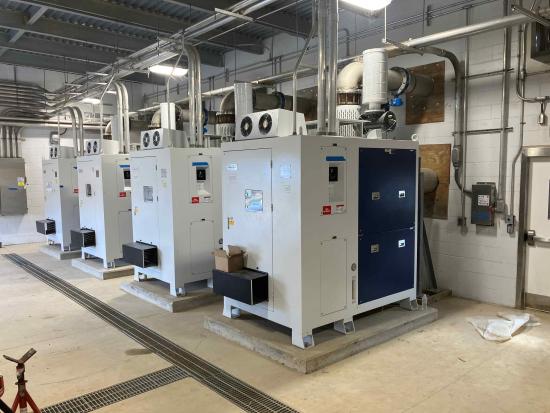
Four turbo aeration blowers at a major poultry producer.
Municipalities have their own requirements about what can be discharged to their sewer systems. Municipal treatment relies on primary-secondary-tertiary trains tailored to more dilute, stable domestic sewage. This difference drives variations in design, operation, materials and regulatory compliance requirements across the two sectors.
“Let's simplify it and say a customer has an ammonia limit of no more than 1 gram per million, but starts at 5 grams per million. Also, it must have a certain level of solids, let's say no more than 5 grams per million. Those are permit requirements. For it to operate that facility, it must have a prior agreement with the municipality that it’s working within the limits of the permit,” Hammoud said. “The plant must be inspected. A membrane comes to take out the solids, like a strainer. You get rid of contaminants, then you percolate it with oxygen. You add some chemicals to kill strong bacteria and make it less concentrated. Once you reach that limit, by the end of the process, you go into the discharge.
“If, for some reason, for a certain period of time, the plant isn’t able to meet those levels, it has to send a notification saying it needs to treat more. That's when the customer comes to us, and often it’s under stress. It may have received a cease-and-desist order or a set time to fix the problem. It sends us its requirements in a plan, and our process experts help it design the requirements. From there, we define the blowers that will deliver the requirements and the aeration system that will control that process operation.”
Food and Beverage Plants Seek Out More Efficient Aeration Blowers
The company often provides engineering support to customers. For a recent project with a major food producer, the company was asked to help with the goals of increasing capacity and saving energy.
“We took its requirements and worked with the customer, going back and forth on design iterations, to establish or confirm the treatment requirement. Once we defined the treatment requirement and the amount of air required for the treatment, we went into the controls. Then, we worked with it to define the control of the aeration system that includes blowers and valves. From there, we did the rendering. We produced the mechanical design, how equipment will be installed in the blower room and the mechanical arrangements. We supplied the mechanical design, and it hired a local contractor. It bought the equipment from us, took our design, put it in the blower room, connected the pipes and fittings and installed the valves. Then, our commissioning team commissioned the system and began normal operation,” Hammoud said.
The company did something similar for a major bread producer. The customer wanted to double its capacity at one facility but didn’t have a design engineer or an outside engineer. The company took the lead by analyzing the requirements, specifying the equipment needed and connecting the customer with mechanical and electrical designers. Throughout the process, the customer was comfortable that the company had the know-how to help design its new system. Hammoud estimated the customer saved \$250,000 to \$300,000 in engineering fees, money it could put to use optimizing its system.
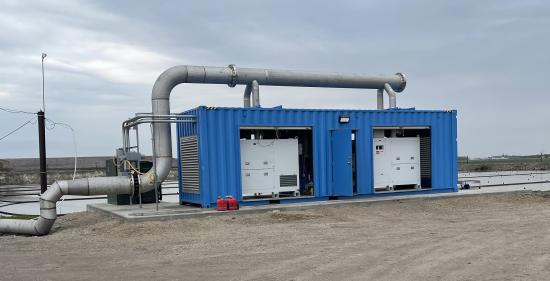
Turbo aeration blowers at a major sugar refinery.
Many food and beverage plants have their own unique challenges. The beverage creation process of a major soft drink creates wastewater that needs to be treated before it can be discharged to municipal sewers. A major yogurt company ferments milk in its production, and that creates a byproduct that needs to be treated.
At these plants, wastewater is stored in a basin or a lagoon. Basins are more common in urban environments where space is limited, while remote operations favor lagoons. The collection system is also influenced by state and local regulations dictating the type of treatment needed before wastewater can be discharged.
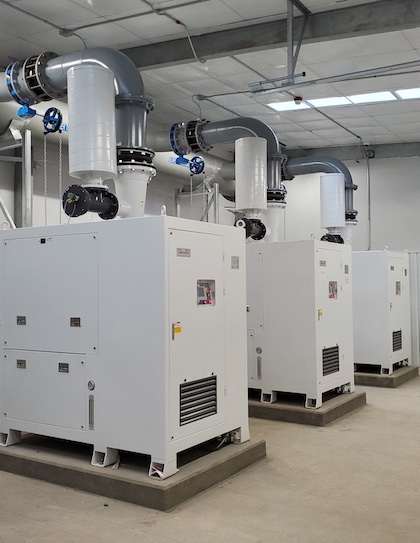
These turbo aeration blowers were installed in a food processing plant in Washington in 2020.
Pulp and Paper Byproducts Need to Be Removed from Wastewater
In the pulp and paper industry, the company has worked with a major paper consumer goods manufacturer since 2010 at multiple plants. Byproducts for that industry include bleach, calcium and other minerals. These need to be removed before wastewater can be discharged. Discharge limits for pulp and paper producers are regulated by Title 40 of the Code of Federal Regulations, Part 430.
How pulp and paper plants discharge their wastewater varies by location. If the plant is in a suburb, for example, it discharges to a sewer system, but if it’s in a remote location, it treats and discharges its wastewater in lagoons, letting it seep into the ground and dissipate to the underground water system.
“We assist them with efficiency and modernization. We don’t just supply the equipment, but also do a lot of work helping with the design of the system. It’s the same thing I mentioned with our poultry customers. Many of them don't have an engineer designing with them. They come to us because, based on experiments they have done with us, they know we can design the installation for them. If they need help with the process analysis, we can help them determine how much air they need or which product is the best fit. We also do the mechanical and electrical design for them. Then, they have someone who comes in and installs the turbo blower for them and runs it,” Hammoud said.
The company can provide this level of support because of the team it has assembled, which includes experts in wastewater energy efficiency.
“They know the process. They know how to find places to improve operational efficiency,” Hammoud said. “We've put them together, and they do the analysis of the entire system and help define the roadmap to get better efficiency with the right equipment. They can save a lot on engineering fees. We're not saying we're replacing the engineering design team. We're saying some customers may not have the budget, or perhaps the engineering company they work with is small. If they can get a technical solution that helps them, then they’ve found an easier way of getting results at lower costs because we don't charge for our services.”
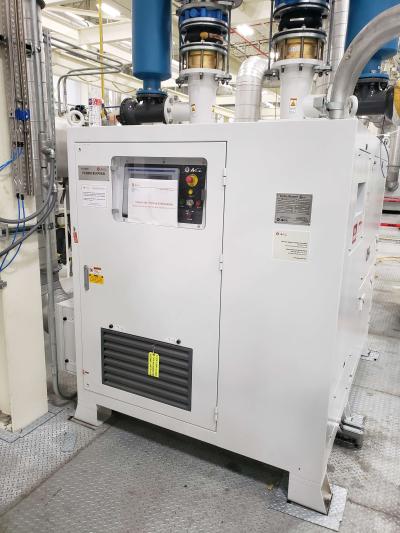
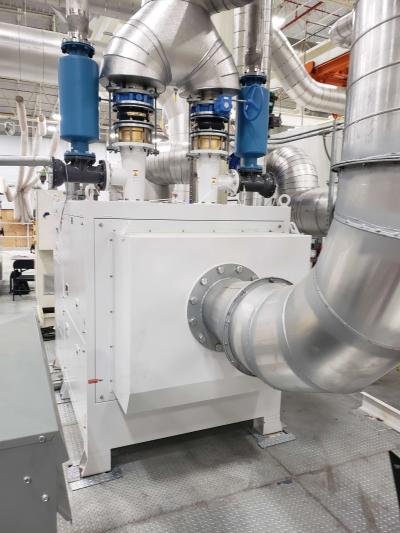
The turbo aeration blowers in these pictures were installed for a major paper consumer goods manufacturer in 2019.
Thorough Turbo Blower Testing Provides 99% Availability
When plants move to multi-stage turbo blowers, they reduce their energy consumption and gain greater control over the aeration process, Hammoud said. The company provides a system controller with turbo blowers to help optimize their output.
Other benefits of upgrading to newer equipment include smaller space requirements, less noise and reduced maintenance needs. Many plants are stretched thin, he noted, and need to focus on product rather than maintenance tasks.
The company’s goal is to provide 99% availability on its turbo blowers, which it achieves through product design and testing. All designs and components are reviewed and tested by Underwriter Laboratories (UL) and the Canadian Standards Association (CSA). The company does its own testing, as well, running every machine for 150 hours. Turbo blowers are run at extreme conditions with vibration, temperature and electromagnetic interference measured to ensure everything works as it should.
“We do this with every product line before we make it available commercially,” Hammoud said. “When we make it available commercially, the product line has a UL stamp and a CSA stamp on it. That guarantees the quality of every component in the system and the entire system as a whole.”
The company also runs performance tests to ensure customer-specific requirements function as they should. If a turbo blower includes a modified impeller design to optimize it for one particular use, the company tests it for three to four days at its own testing facility. When testing is complete, it sends preliminary data to the customer. If the company has any concerns, it makes changes and retests the equipment. It even invites customer engineers inside its facility to observe or run their own tests. Sometimes, these visits take weeks.
Aeration Blowers with Air Foil or Magnetic Bearings
While the company got its start producing turbo blowers with air foil bearings, it introduced magnetic bearings to all its product lines in 2019. For every product from roughly 100 to 1,500 horsepower (hp) it offers a continuous air foil or magnetic bearing line.
“With magnetic bearings and air bearings, you have flexibility in terms of speed and torque,” said Hammoud. “Every installation is run through our modeling, and we can optimize it. We can select the motor that gives the best impeller characteristics for that installation. That gives us better efficiency.”
Surge prevention is not the deciding factor on which bearing type to select. “Surge primarily is control. It's not dependent on the bearing,” he said. “You have to have sophistication in the control system to predict surge and prevent it, not control it after you have a surge.”
About APG-Neuros
Founded in 2005, APG-Neuros is recognized as the force behind the successful introduction of high-speed turbo blower technology in the wastewater treatment markets in North America, Western Europe and the Middle East. Its turbo blowers are used in a variety of industrial applications and wastewater treatment processes, with over 1,900 units installed in North America and Europe, and more than 8,000 units worldwide. Its headquarters are in Quebec, Canada, and its manufacturing and testing facility is in Plattsburgh, NY. For more information, visit https://apg-neuros.com.
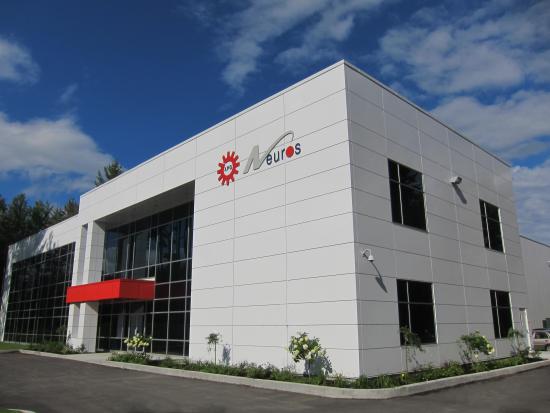
The APG-Neuros headquarters in Quebec, Canada.
To read articles on Aeration Blowers, visit https://www.blowervacuumbestpractices.com/technology/aeration-blowers.
For expert presentations, visit our Webinar Archive Section dedicated to Aeration Blowers at https://www.blowervacuumbestpractices.com/magazine/webinars.