Technology

By Kyle Kopac, Supervisor, Product Management, Vacuum Automation, Schmalz

Suction rate, nozzle diameter, degree of evacuation, generator intelligence and air or energy consumption! These are only a few of the factors engineers need to consider when determining the best vacuum generation source for a custom-engineered gripping system.

Understanding Positive Displacement and Centrifugal Blowers

By Tom Jenkins

Learn the key differences between positive displacement (PD) and centrifugal blowers and how advances in blower technology, variable-speed controls and lifecycle cost analysis are reshaping equipment selection. This article explains blower operating principles, performance characteristics and application considerations to help engineers optimize energy efficiency, reliability and long-term operating costs in wastewater, industrial and process air systems.

Wolf Nudeln Reduces Water Use with Claw Vacuum Pumps

By Lisa Glatt, Head of Marketing, Busch Austria

By replacing liquid ring and compressed air systems with centralized rotary claw vacuum pumps, Austrian pasta manufacturer Wolf Nudeln significantly reduced water consumption, maintenance requirements and operating costs. This case study demonstrates how modern vacuum technology improves efficiency, reliability and product quality in food manufacturing while supporting long-term sustainability goals.

The ROI of Proper Filtration

By Bella Alfaro, Marketing Coordinator, and Rich Ricciardi, Market Manager, Solberg Manufacturing

This article examines how industrial facilities can quantify the return on investment associated with disciplined filter change scheduling. By connecting pressure drop, energy consumption, maintenance costs and equipment longevity, facilities can move from reactive maintenance to measurable operational control.

Designing Vacuum Processes for Greater Efficiency

By Meike Strasheim, Head of Market Management Content Strategy, Pfeiffer Vacuum+Fab Solutions

Efficient vacuum systems are built through thoughtful process design, not just equipment selection. This article outlines four critical strategies to improve performance and reduce operating costs: using multiple pumping stages to optimize efficiency across pressure ranges, managing vapor loads through pre-condensation, preventing performance losses from condensates and carryover and controlling operating temperatures. By addressing these factors early in the design phase, facilities can enhance productivity, lower energy consumption and ensure long-term reliability of vacuum processes.

Aeration Blowers in the Food Industry

By Bob Kisler, Regional Sales Manager, Hoffman & Lamson, and Doreen Tresca, Marketing Manager, SSI Aeration

From managing complex wastewater streams to protecting stored grain and sustaining fish health, effective airflow is essential to maintaining product quality and operational stability. How advances in blower technology, diffuser materials and automated controls are helping facilities improve efficiency, reduce energy use and meet increasingly strict environmental requirements.

GlobalVac & Air Upgrades the Dalton Cardiovascular Research Center

By Troy Dreier, Senior Editor, Blower & Vacuum Best Practices Magazine

An aging 103 acfm oil-free rotary claw vacuum system was replaced with a skid-mounted duplex configuration featuring two 5.4 hp pumps, automated lead/lag controls and an inlet purge system to handle increased laboratory demand and prevent chemical contamination. The upgraded system delivers up to 106 acfm and 28”Hg, providing higher vacuum capacity, redundancy and improved operational stability within a constrained mechanical room footprint.

Best Practices 2025 EXPO & Conference Blower & Vacuum Show Report

By Troy Dreier, Senior Editor, and Brooke Jones, Digital Content Editor, Compressed Air Best Practices® Magazine 

The Best Practices 2025 EXPO & Conference contained plenty of sessions for industrial vacuum, blower and aeration blower professionals, including conference tracks, workshops devoted to pneumatic conveying and blower engineering and original equipment manufacturers on the EXPO floor.

Aeration Blowers, Motors & Drives at Weftec 2025

By Roderick M. Smith, Editor, Blower & Vacuum Best Practices Magazine 

Weftec 2025, a leading event for industrial and municipal wastewater treatment plant (WWTP) technologies, took place September 29 to October 1, 2025 at Chicago's McCormick Place. The objective of this article is to provide readers with a sampling of aeration blower, motor and drive technologies on display.

APG-Neuros Aeration Blowers Treat Industrial Wastewater

By Troy Dreier, Senior Editor, Blower & Vacuum Best Practices

Different industries have differing levels of toxins and contaminants that need to be reduced before wastewater can be discharged. The company specializes in understanding those requirements and creating custom turbo blowers to customer specifications. Its leading industries are pulp and paper, poultry and food and beverage.

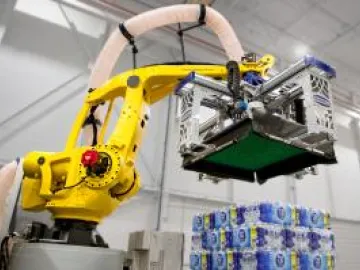
Vacuum Generation Source Selection for Robotic Gripping Systems

By Kyle Kopac, Supervisor, Product Management, Vacuum Automation, Schmalz

Suction rate, nozzle diameter, degree of evacuation, generator intelligence and air or energy consumption! These are only a few of the factors engineers need to consider when determining the best vacuum generation source for a custom-engineered gripping system.

What Is Most-Open-Valve Aeration Blower Control?

By Bob Kisler, Regional Sales Manager, Hoffman & Lamson, and Doreen Tresca, Marketing Manager, SSI Aeration

Most-Open-Valve (MOV) control is a common automatic dissolved oxygen (DO) control system. By reducing the required aeration blower discharge pressure, MOV can improve basin efficiency and reduce power requirements if the MOV and aeration blower controls are properly coordinated.

Blow-off Savings at an Aluminum Casting Plant

By Alper Alten, Founder, AAPM Project Management and Consulting

This article explores how a focused engineering intervention driven by data and a clear understanding of process requirements led to a transformative change on a aluminum production plant. By switching from traditional compressed air systems to low-pressure industrial blowers the plant not only maintained product quality, but also achieved a dramatic reduction in energy use saving nearly $455,000 annually.

Vacuum Generators and Pneumatics Power Robotics at Automate 2025

By Troy Dreier, Senior Editor,  Blower & Vacuum Best Practices Magazine

Automate 2025, showed attendees how to make their industrial plants more efficient with robotics. Throughout the conference, robotic arms shuttled packages, burgers and even macarons with speed and accuracy. Driving this new technology was a complex network of pneumatic cylinders and pick-and-place automation powered by pneumatic vacuum generation. Innovation makes these proven technologies more efficient than ever.

Optimizing Wastewater Treatment with a High-Performance Aeration Blower System

By Sam Gooldy, Senior Manager, Marketing and Product Development, UCA

In a strategic move to enhance environmental sustainability and operational efficiency, Universal Compressed Air (UCA) partnered with a leading waste services provider in the Southeast to design, build, own, operate and maintain a state-of-the-art blower System for wastewater pond aeration. This innovative solution, part of a five-year agreement, delivers over 20,000 scfm of low-pressure air while guaranteeing uptime, performance and significant cost savings.

Industrial Vacuum System Basics

By Benjamin Cameron, Business Line Manager, Vacuum, Quincy Compressor

The objective of this article is to make vacuum systems a little less confusing by providing some foundational vacuum principles. Naturally, the best place to start is with an examination of air compressors! Air compressors take air from an open system (the atmosphere) and discharge it into a closed system, resulting in a higher pressure. The potential energy of high-pressure air is then used to serve an operational purpose.

Dual Point Aeration Blower Control

By Tom Jenkins, President, JenTech Inc.; Jun Inai, Senior Design and Project Engineer, and Hayato Sakamoto, Principal Project Leader, Kawasaki Heavy Industries

Historically, the most common dual point control has been combining inlet guide vanes and variable discharge diffuser vanes. These are both mechanical systems and predate the availability of economical variable speed control. Recent advances in power electronics technology and improved VFD economics have led to implementing other combinations for dual point control. These include combining VFD control with either VDVs or IGVs.

A Guide to Vacuum Pump Sizing

By Michael Ruff, Business Development & Technology Director, Becker Pumps Corporation

Know Your Vacuum Pump Application Key Vacuum Pump Sizing Terms Moving Different Gasses with a Vacuum Pump Vacuum Pump Size and Total Volume Tips to Consider When Choosing a Vacuum Pump

Advanced Aeration Control for Blowers

By Tom Jenkins, President, JenTech Inc.

The ideal blower control matches the blower airflow to the process demand. The process demand, in turn, must be established by the aeration control system. This control strategy has become standard practice in most treatment facilities because of its proven effectiveness in reducing energy consumption and improving process stability.

Centralized vs. Point of Use Vacuum Filtration

By Jamie Stebbins, Solberg Manufacturing

In this article, we will isolate and review one system common to many plants and industries: the vacuum system. Within this system, we will further drill down to the filtration required to maintain a healthy process, which contributes directly to the bottom line. The vacuum system does not exist in many production process lines without filtration. Throughput and quality of the end product are closely tied to the necessary vacuum levels achieved when filtration is properly deployed.

7 Best Practices for Leak Detection in Vacuum Systems

By Sinja W. Stentoft, Editor Communications, Busch Vacuum Solutions

Leaks in vacuum systems can cause considerable damage to sensitive industrial processes. The vacuum pump’s ability to generate and maintain the desired vacuum level is compromised as the process gas escapes the pump or contaminants – such as air, dust and debris – enter. This leads to accelerated wear and tear of internal components such as seals and gaskets, and the vacuum pump may fail or require more frequent servicing. As a result, energy bills and overall operating costs increase drastically, while output quality suffers.

pdblowers Soars in Aerospace Vacuum System Installation

By Blower & Vacuum Best Practices Magazine

The aerospace division of a large industrial manufacturer, uses a large altitude simulation chamber to test aircraft parts at different atmospheric conditions. It was based on this application, that the pdblowers team created what the facility needed: a multi-stage vacuum system that could manage varying mass flows at different vacuum levels.

Calculating Aeration Piping Friction Loss

By Tom Jenkins, JenTech Inc.

In order to properly identify the performance requirements of a blower it is necessary to identify the inlet and discharge pressures. The friction losses in the inlet and discharge piping must be calculated to determine the total pressure requirement. This article details a simplified procedure for calculating piping losses.

6 Maintenance Tips for Winterizing Your Vacuum Pumps

By Robert Stevens, Engineering and Marketing Manager, Busch Vacuum Solutions

When cold weather approaches, safeguarding the performance and longevity of your vacuum pumps becomes a top priority. Cold conditions pose unique challenges that can affect the reliability and efficiency of these crucial industrial components. At Busch Vacuum Solutions, we understand the importance of winterization in preventing corrosion, freezing and other potential damage. In this guide, we’ll share tips to ensure your vacuum pumps continue to operate optimally during the colder months.

Vacuum Receivers: Full of Vacuum or Full of Myth?

By Jackson Redline, Engineered System Solutions Project Manager, Rogers Machinery

In this article, we’ll discuss some of the uses for receiver tanks for positive pressure systems where the pressure inside the system is greater than atmospheric pressure, and the uses, or lack thereof of, receiver tanks in vacuum systems where the system pressure is less than atmospheric pressure.

When to Repair vs. Replace Your Vacuum Pump: A Guide

By Mary MacGregor Velhinho, Busch Vacuum Solutions

If your vacuum pump is malfunctioning, you are faced with a choice: repair or replacement. Our guide will take you through both options and provide recommendations on when it makes sense to repair vacuum pumps and when to replace them. We will also take a look at how to spot and diagnose common issues before they lead to system failure. Whatever the path of action, the decision to repair or replace always begins with testing and diagnosis. A factory-trained service technician who specializes in vacuum pump services inspects the equipment and identifies the problem.

Aeration Blowers

Air Knives - Nozzles

Industrial Blowers

Measurement

Medium/High Vac

Purification

Rough Vac

Vac Generation