Sizing a vacuum pump can seem daunting, but it doesn’t have to be. Learn these tricks to make the process easier and less stressful. Keep in mind, you don’t need to be exact. A rough estimate is often good enough. Focus on the key factors.
Know Your Vacuum Pump Application
When starting your vacuum pump selection, think about the following:
- Flow Rate: What volume of air or gas needs to be moved per unit of time?
- Vacuum Level: What is the desired pressure?
- Gas Properties: What are the characteristics of the gas being managed?
- Duty Cycle: Will the pump operate continuously or intermittently?
- Environmental Factors: Are there temperature, humidity or noise restrictions?
- Total System Volume: What is the total volume of the space being evacuated?
Key Vacuum Pump Sizing Terms
Flow Rate: Are you looking for actual cubic feet per minute (acfm) or standard cubic feet per minute (scfm)?
acfm measures the actual volume of air the vacuum pump can remove in one minute under specific conditions (including temperature, pressure and altitude). scfm measures the volume of air the vacuum pump can remove in one minute under standard conditions (usually 68°F [20°C], 14.7 psi [1 bar], and 0% relative humidity). Standard conditions vary by pump manufacturer.
A vacuum pump removes air from a space. acfm tells you how much air it can remove right now, while scfm tells you how much it can remove under ideal conditions. This is important because the performance of a vacuum pump can be affected by factors such as the size of the space it’s evacuating, the type of air it’s removing and the altitude.
acfm gives you the real-time performance of a vacuum pump, while scfm provides a standardized measurement for comparison.
It’s crucial to specify whether you’re working with acfm or scfm measurements when discussing vacuum pump requirements with a supplier. Using the wrong measurement can lead to oversizing or undersizing the vacuum pump. Volume flow vs. pressure curves are often presented in both acfm and scfm. Using the correct curve ensures an accurate performance evaluation. Also, when comparing vacuum pumps, it’s essential to use the same unit for a fair comparison.
When contacting a vacuum pump supplier, state whether you are interested in acfm or scfm flow rates. This will help them provide you with accurate recommendations and ensure the selected vacuum pump meets your needs.

This graph shows the relationship between scfm and acfm on a V/P curve used by vacuum pump manufacturers. It illustrates the relationship between suction air rate (cfm) and vacuum level (torr) at different frequencies (60 Hz and 50 Hz), showing how the suction air rate decreases as the vacuum level increases for both frequencies, with the 60 Hz curve exhibiting a higher suction air rate than the 50 Hz curve at a given vacuum level. Click to enlarge.
Ambient and Atmospheric Pressure: These are the same thing. Both refer to the pressure of the air around you.
Absolute Pressure: The total pressure, including atmospheric pressure. It’s measured relative to a perfect vacuum.
Gauge Pressure: The pressure measured relative to atmospheric pressure. It’s what you would see on a typical pressure gauge.
Imagine a jar:
- Atmospheric pressure is the weight of the air pushing down on the jar.
- Absolute pressure is the total pressure inside and outside the jar.
- Gauge pressure is like measuring how much pressure there is inside the jar compared to the outside.
If you remove the air from the jar, the gauge pressure becomes negative. This is because the pressure inside is lower than the pressure outside.
In vacuum applications, absolute pressure is the total pressure, including the atmospheric pressure. Gauge pressure is the pressure difference between the inside and outside of the vacuum chamber. It’s negative in a vacuum because the pressure inside is lower. Here’s a simple formula to remember: Absolute pressure = gauge pressure + atmospheric pressure.
For example, If atmospheric pressure is 14.7 psi (1 bar) and gauge pressure is -10 psi (-0.7 bar meaning 10 psi or 0.7 bar below atmospheric pressure), the absolute pressure would be 14.7 psi plus -10 psi [1 bar plus -0.7 bar]), or 4.7 psi (0.3 bar).
In vacuum applications, absolute pressure is often used to measure the pressure inside a vacuum chamber. Gauge pressure is often used to measure the difference between the pressure inside the chamber and the atmospheric pressure. Gauge pressure tells you how empty the vacuum chamber is, while absolute pressure tells you the total pressure inside.
Just as with volume flow, you need to specify whether you are working with relative (gauge) or absolute pressures when discussing vacuum pump requirements with a supplier.
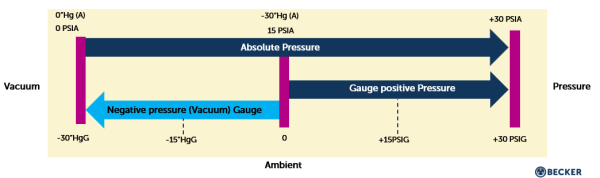
Absolute pressure is measured relative to a perfect vacuum, while gauge pressure is measured relative to atmospheric pressure. Click to enlarge.
If a customer says, “I need a vacuum pump that can provide 28 cfm and 14”Hg,” without asking more, the vacuum pump supplier might size and quote based on these units, as shown in Figure 1.

Figure 1. This graph illustrates the performance of a vacuum pump, showing that as vacuum level increases (lower pressure), the volume flow rate decreases. Click to enlarge.
However, the customer could later say the vacuum pump is not working for their application. That’s because the customer requires a pump able to maintain a flow rate of 28 cfm while achieving a gauge pressure of 14"Hg, as shown in Figure 2.

Figure 2. The graph depicts the performance of a vacuum pump, showing an open flow of 61 scfm, an end vacuum of 28"Hg. When running at 14"Hg, the available scfm is 28. Click to enlarge.
The first vacuum pump was undersized due to a lack of clarity. By providing additional information, you ensure the selected vacuum pump meets your needs and performs as required.
Moving Different Gasses with a Vacuum Pump
When dealing with gases other than the air we breathe, several factors must be considered. While vacuum pump manufacturers can provide guidance, understanding gas composition is crucial. Incorrect use of equipment could lead to major safety concerns.
The air we breathe is primarily composed of nitrogen, oxygen and argon, with trace amounts of other gases including carbon dioxide, water vapor and ozone. Different gases have different molecular weights and viscosities. Heavier gases like carbon dioxide may need higher pumping speeds.
When working with a mixture of gases, the dominant gas dictates the overall pumping requirements. However, the presence of other gases, especially those with low boiling points or flammable properties, can significantly impact the achievable vacuum level and introduce safety risks.
If a gas mixture contains flammable components, there is a risk of fire or explosion if proper precautions are not taken. Vacuum pumps must be selected and operated in a manner that minimizes the risk of ignition.
Flammable gas types:
- Hydrocarbons: Methane, propane, butane, ethylene and acetylene.
- Solvents: Gasoline, benzene and toluene.
- Natural gas: A mixture primarily composed of methane.
Some gases can react with other substances or with the vacuum pump itself, leading to hazardous conditions. It is essential to consult with the manufacturer to choose a pump compatible with the specific gases being managed.
Reactive gases:
- Halogens: Chlorine, fluorine and bromine.
- Hydrogen: A highly reactive gas.
- Oxygen: It can react with many substances, especially in the presence of a heat source or catalyst.
- Ammonia: A highly reactive gas that can form explosive mixtures with air.
- Nitrous oxide: A strong oxidizing agent that reacts with many substances.
Vacuum Pump Size and Total Volume
Once we’ve established the gas properties, flow rate and desired vacuum level, we can focus on vacuum pump size. Vacuum pump manufacturers offer a wide range of vacuum pump sizes, each capable of managing a specific volume of air within a given time.
The system the vacuum pump is connected to represents the total volume that needs to be evacuated each time the pump is activated. This total volume directly influences the pump's required cfm.

The image depicts a system with two receivers, totaling 1,240 gallons, connected to a plumbing system with 100 feet of 3-inch pipe and 30 feet of 2-inch pipe, resulting in a total system volume of 1,282 gallons. Click to enlarge.
We need to account for all volumes the vacuum pump must evacuate. In this image, we have a total of 1,282 gallons to remove before the vacuum becomes available to the user.
Vacuum and Flow Relationship
Vacuum and flow are inversely proportional. A higher flow rate leads to a lower achievable vacuum level. During startup, the time to reach a specific vacuum level is typically short. However, as the vacuum level decreases, it takes longer for the vacuum pump to remove the remaining volume.

The evacuation time for the total system volume decreases with increasing pump capacity. A higher capacity pump achieves faster evacuation times compared to a lower capacity pump. Click to enlarge.
If you have a specific time requirement to reach a desired vacuum level, be sure to communicate this to the vacuum pump manufacturer.
Selecting a Vacuum Pump
Once we have established the essential factors for vacuum pump sizing, we can select the most suitable vacuum pump type. There’s an array of vacuum pump styles available, each with unique characteristics.
Common technologies used for vacuum pumps:
- Rotary vane: A rotating rotor with vanes (flat, blade-like components made of a carbon-resin blend) creates a vacuum by displacing air.
- Screw: Two intermeshing screws create a vacuum by compressing and displacing air.
- Claw: Two intermeshing claw-shaped rotors create a vacuum by trapping and compressing air.
- Diaphragm: A diaphragm oscillates to create a vacuum by displacing air.
- Rotary piston: A rotating piston creates a vacuum by displacing air.
- Liquid ring: A rotating impeller creates a liquid ring that traps and compresses air.
- Dry scroll: Two intermeshing scroll-shaped elements create a vacuum by trapping and compressing air.
- Regenerative blower: This uses a rotating impeller with vanes to create a centrifugal force drawing air into the pump and forcing it out.
- Radial blower: This is a type of dynamic vacuum pump. It uses a centrifugal impeller with radial blades to create a high-velocity flow of air or gas.
Tips to Consider When Choosing a Vacuum Pump
Vacuum pipe loss starts to occur around 100 feet of length. Keep the plumbing diameter equal to the inlet port of the vacuum pump for as far as possible. Increase the plumbing diameter by one increment (for example, from one inch to two inches) every 100 feet. For exhaust plumbing, avoid backpressure by increasing the diameter every 30 feet.
When calculating total system length, consider the equivalent pipe length of 90-degree elbows. These can introduce additional resistance to airflow, effectively increasing the system's length. This impacts the overall pressure drop and flow rate.
|
90-degree elbow (inches) |
1/2 |
3/4 |
1 |
1 1/4 |
2 |
2 1/2 |
3 |
4 |
5 |
6 |
|
Equivalent length (feet) |
0.8 |
1.2 |
2 |
2 |
3 |
4.4 |
5 |
7 |
9 |
10 |
Altitude significantly impacts the performance of vacuum pumps, especially those relying on atmospheric pressure for their operation. At higher altitudes, atmospheric pressure is lower, which can affect the achievable vacuum level. For every 1,000 feet above sea level, the vacuum level is lowered by approximately one inch of mercury. Higher altitudes can affect the cooling efficiency of the pump's motor, leading to increased temperatures and potentially shortening the motor's lifespan. If you are operating at a significant altitude, it is a good idea to let the pump manufacturer know.
A vacuum pump selection checklist:
- Choose a pump that can achieve the required vacuum level.
- Select a pump with a sufficient flow rate to manage the required volume of gas.
- Consider the gas type, composition and any potential contaminants.
- Evaluate the pump's maintenance needs and costs.
- If noise is a concern, choose a pump with noise-reduction features.
- Consider the initial purchase cost and ongoing operating expenses.
By carefully evaluating these factors, you can select a vacuum pump that provides the best performance, reliability and customer experience for your application.
About the Author
Michael Ruff has over 17 years of industrial vacuum pump experience. He specializes in providing clear solutions for complex vacuum pump challenges.
About Becker Americas
Becker is a leading provider of vacuum pumps, air compressors and regenerative blowers. Its global headquarters is in Wuppertal, Germany, and its American headquarters is in Cuyahoga Falls, OH. For more information, visit https://beckerpumps.com.
To read similar Vacuum Technology articles, visit https://www.blowervacuumbestpractices.com/technology/medium-high-vac.
Visit our Webinar Archives to listen to expert presentations on Vacuum Technology at https://www.blowervacuumbestpractices.com/magazine/webinars.