
Suction rate, nozzle diameter, degree of evacuation, generator intelligence and air or energy consumption! These are only a few of the factors engineers need to consider when determining the best vacuum generation source for a custom-engineered gripping system.

A vacuum terminal with integrated IO-Link or Ethernet interface.
At Schmalz, engineers regularly work with customers in the packaging, logistics, wood, metal, glass, plastics, food, beverage, pharmaceutical, chemical and composites industries to develop gripping systems meeting their specific environment and needs.
Engineers need to consider many factors when deciding what will work best for a customer’s application. Our company is the resource for custom area gripper applications with layer grippers, palletizers and spider gripping systems. Our engineers take into account a myriad of factors to determine what vacuum generation source will work best for the need.
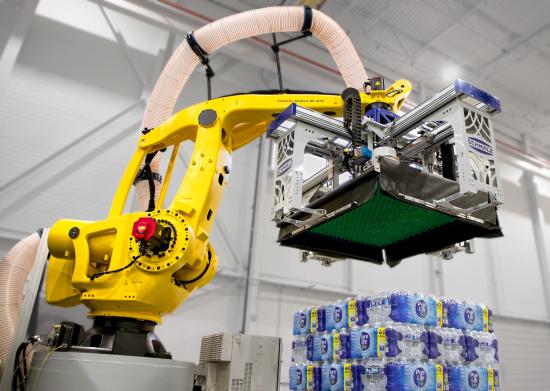
A modular layer gripper primarily used in the food industry.
Listed roughly in the order of importance, these factors include:
- What degree of evacuation (or vacuum level) is the generator capable of reaching, and does that meet the requirements of the tool?
- What are the maximum and minimum suction rates required by the tool or product?
- What kind of environment will the system be used in? Will there be dirt and debris contamination, extreme temperatures, liquid contamination, electrical conductivity or static discharge?
- What intelligence is required of the generator? Does it need to have a vacuum switch, built-in valves, Ethernet or an IO-Link?
- Considering the project requirements, what is the availability or lead time of the vacuum generator itself?
- What is the cost of the generator as a complete package? This includes cabling, mounting equipment and the cost of time to integrate it into the system.
- What is the generator’s air and energy consumption?
- Given the customer or manufacturing facility requirements, what is the serviceability of the generator?
- What is the noise level of the generator?
The answers to these questions drive the design of the system. We offer a wide range of vacuum generation options, and the engineers use the answers as they review them and consider how the system will be used.
The options most used in layer grippers, palletizers and spider gripping systems are vacuum blowers, vacuum pumps, compact ejectors, compact terminals and basic ejectors.
Robot Grippers Made-to-Measure
When a project requires suction spider grippers, engineers design them individually according to the application’s specific needs. All versions of these grippers are derived from a basic modular design that can be flexibly optimized for complex handling tasks.
The grippers are beneficial in numerous automation processes and across various industries. For example, they are particularly useful in the automation of handling sequences in manufacturing, assembly and quality inspection processes. They also help interlink robots in presses and bending centers, as well as in picking operations in warehouses and distribution centers using industrial robots or gantries.
In addition, they are used in the automation of plastic injection molding and thermoforming machines, wood and plastic machining centers, waterjet, laser and punching machines. Finally, the grippers are adept at handling metal profiles, blanks, stones, sheet material, car body parts, glass and ceramic components and solar panels.
The basic components of these grippers are made of aluminum, steel tube and plastic, which enables fast cycles. In addition, the grippers provide increased process reliability through integrated system monitoring and sensor technology.
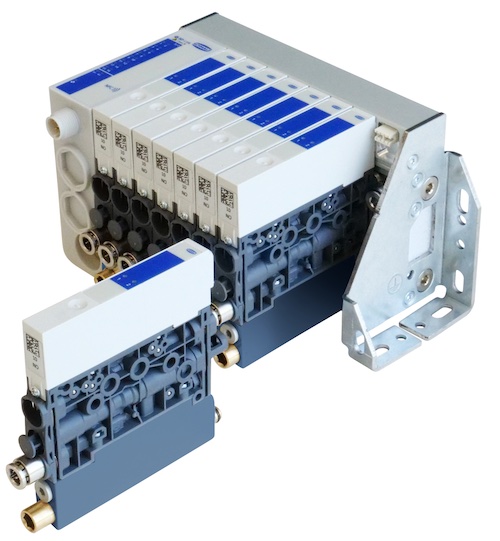
Inserting a compact ejector into a vacuum terminal.
System Solutions for Palletizing Applications
When a modular layer gripping system is needed for handling complete or partially loaded workpiece layers, engineers can choose from a light version for loads up to 77 lbs (35 kg), a standard version for loads up to 551 lbs (250 kg) and a full version that includes a global vacuum. These complete gripping systems are ready to connect for industrial robots, cobots or gantries, can handle workpiece layers such as cardboard boxes, glasses and cans and are ideal for end-of-line palletizing.
The SPZ is a layer gripper used to connect to industrial robots or gantries to typically handle homogenous workpiece layers. It has a load capacity of up to 551 lbs (250 kg). The SPZ-MC is a modular layer gripper with three different gripping principles: suction cup carpet, global vacuum and mechanical clamping. It can grip almost any workpiece layer regardless of height, including shrink-wrapped products and open-top boxes.
The ZLW is a turnkey solution for lightweight gripping and is used mostly in collaborative robotic applications or lighter-payload industrial robots, as it doesn’t add much to the overall payload. Its contoured shape ensures there are no sharp edges or extrusions that could hurt a person collaborating with the robot. It is individually configurable in length and width, and has a maximum load capacity of 77 lbs (35 kg).
Functional Testing of Custom Gripping Systems
Once engineers design and build a custom system, they thoroughly test it through trials using original workpieces from the customer.
This testing step is an important part of the creation process and ensures excellent performance and a high degree of safety. During the testing, engineers identify possible weak points and determine suitable solutions. As a result, they’re able to guarantee systems operate smoothly and can be integrated into a customer’s processes easily.
This testing phase is the final stage in creating custom gripping systems. Throughout the entire process, from conceptualizing what is needed to identifying the gripper specifications to testing the solution thoroughly and then bringing the system to fruition, engineers consistently demonstrate how they are the best resource for custom area gripper applications.
About the Author

Kyle Kopac is the Supervisor, Product Management, Vacuum Automation at Schmalz, where he leads product strategy and development for vacuum-based automation solutions. With a background in applications engineering and a deep understanding of gripping technologies, he works closely with customers to identify and implement the most effective vacuum technologies – including ejectors, pumps and universal gripping systems – based on their unique process requirements.
About Schmalz
Schmalz is a leader in vacuum industrial automation and ergonomic material handling solutions. It offers packaging, food, pharmaceutical, ergonomic and robotic solutions thanks to investment in technologies and the acquisition of products from Binar Handling, Palamatic and mGrip. For more information, visit https://www.schmalz.com.
To read similar Vacuum Generation articles, visit https://www.blowervacuumbestpractices.com/technology/vac-generation.
Visit our Webinar Archives to listen to expert presentations on Vacuum Generation at https://www.blowervacuumbestpractices.com/magazine/webinars.