Duplex Vacuum Pump System Delivers Higher Capacity and Redundancy for University Labs
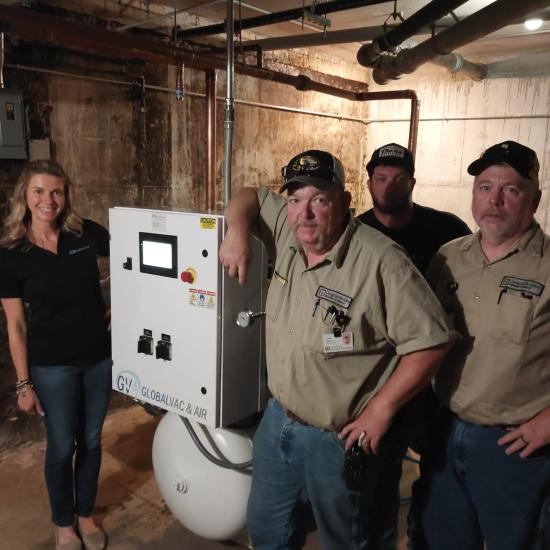
Elizabeth Fleming, Air & Vacuum Systems Sales Engineer, GlobalVac & Air, with Grant Ballard, Machinist Specialist; Codie Haynes, Pipefitter, and Michael Burks, Machinist (left to right), from the University of Missouri Dalton Cardiovascular Research Center.
GlobalVac & Air specializes in engineered vacuum and compressed air systems, as well as mobile engineered solutions for medical, industrial and laboratory environments. Recently, Elizabeth Fleming, Air & Vacuum Systems Sales Engineer, worked with the University of Missouri Dalton Cardiovascular Research Center and Brabazon Pump, Compressor & Vacuum to replace a rotary claw vacuum system. The job involved a special challenge: maneuvering an upgraded duplex vacuum pump system through a small space in the research center’s basement.
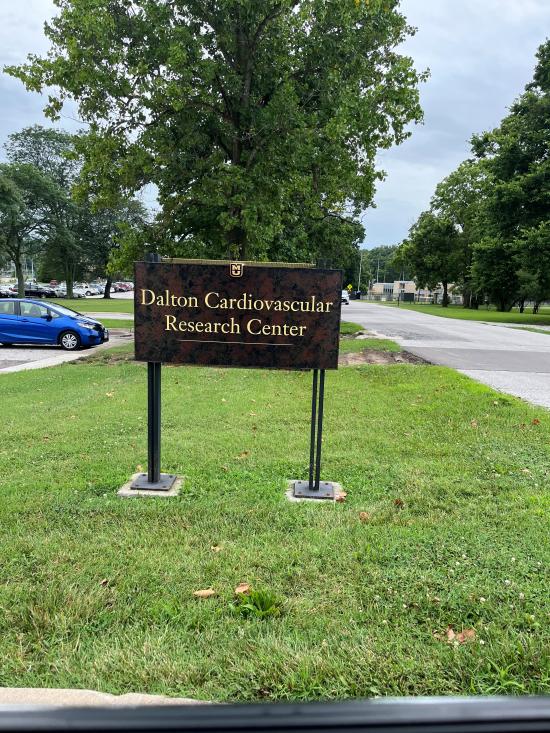
The University of Missouri Dalton Cardiovascular Research Center needed an upgraded vacuum pump system in a small space.
The Unique Vacuum Needs of Medical Research Centers
In research labs, vacuum pump systems are crucial for aspiration (removing liquids or debris), filtration (separating solids from liquids, especially fine particles), evaporation and drying (lowering boiling points to remove solvents), degassing (removing dissolved gases from liquids to prevent bubbles) and sample preparation (concentrating solutions and removing impurities).
The research center allows people from a variety of fields – including engineering, biomedical science, veterinary medicine, general medicine and physiology – to conduct research on the heart, blood and blood vessels. Experiments could involve hormone regulation, the effects of exercise or cardiovascular disease. It already had a vacuum pump system, but the 15-year-old system could no longer maintain 23”Hg and was short-cycling. Additionally, the research center had added more lab stations, putting greater demand on its vacuum system. The research center needed a replacement and an upgrade. It wanted to change its single vacuum pump system to a duplex vacuum pump system.
Selecting the Right Oil-Free, Rotary Claw Vacuum Pump
Brabazon Pump, Compressor & Vacuum is GlobalVac & Air’s largest Midwestern distributor. It already had a relationship with the university, having completed many projects for it in the past. The distributor brought in the opportunity to replace the older rotary claw vacuum system for the university, which the company quoted. Fleming credits winning the job to the distributor’s trusted relationship with the university.
“The job began in February 2025,” Fleming said. “I got an email from Keith Hartoebben, the Pump Manager at Brabazon. He said, ‘I've got an opportunity for a lab vac system needed ASAP.’ It needed to be mounted on a skid and include redundancy or a backup, which means that one pump is running and one pump is not running. He requested a duplex vacuum system with a control panel mounted on a skid.”
The university previously had an oil-free rotary claw vacuum pump system and was happy with the technology. The company sized the vacuum system to match the previous system, but added a second pump to keep up with increased demand. One pump is the lead and the other is the lag, with both pumps working together when needed. A control panel attached to the system automatically alternates which vacuum pump is leading and which is lagging based on pump runtime. The company offered the university several configurations so it could select the best one for its needs and space. The skid also included a storage tank.
The selected 10.8 horsepower (hp) vacuum pump system included two 5.4 hp rotary claw vacuum pumps. It also included an automated inlet purge system to ensure condensed gases don’t contaminate rotors. Lab research often involves ingesting harsh chemicals during experiments. An inlet purge system is important for lab applications and helps extend the vacuum pump’s life. When the vacuum pumps revert to the lag position, the automated system isolates them and allows ambient air to flow through them for a fixed period of time before they go into standby. The pump components are purged of ingested chemicals, which then exhaust outside the building.
The previous vacuum pump system supplied 103 acfm, meaning it pulled 103 cubic feet of air per minute. The new vacuum pump is virtually the same at 106 acfm, but it includes a second vacuum pump for periods of strong demand. The old system supplied 23”Hg, while the new system is capable of 28”Hg.
Fitting an Upgraded Vacuum Pump System into a Small Footprint
The challenge for this installation was getting the duplex vacuum pump system into a small space in the research center’s basement. Because of large pipes blocking the entry, the skid needed to move through a narrow opening before it was installed. The company usually ships its skid system bolted together, but this one had to ship in pieces so it could fit into the space and be assembled on site.
“It was a tight space and a hot room,” Fleming said. “It's the basement of a large old building, so there were tons of pipes of all different sizes, and lots of hissing and steam. I had to duck underneath a pipe to get into the space. That's actually where our equipment usually lives – mechanical rooms in the basements of hospitals and labs. When I got there, the old vacuum system had been removed. We put the new system right where the old one was.”
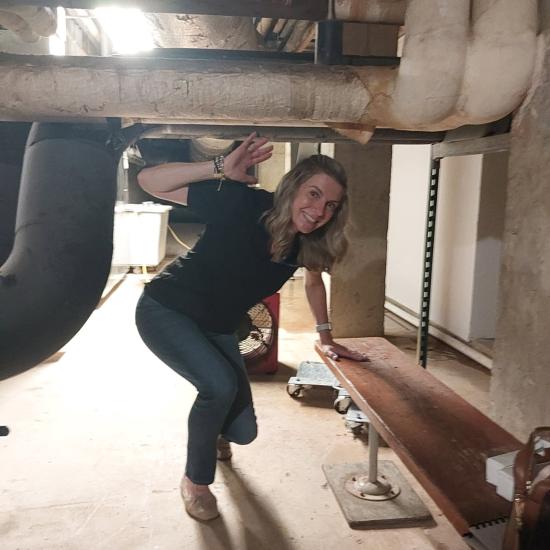
Elizabeth Fleming demonstrated the narrow passage for the duplex vacuum pump system’s installation.
“Brabazon Pump, Compressor & Vacuum has trained technicians. Its service techs are trained and certified to do startups like this out in the field. I was there for the installation, as was the sales rep from the distributor, its service tech, several people from the university, the facilities manager and the manager of the research center,” Fleming said. “The distributor had to take the vacuum system apart to get it into the space. Once it was in the four-by-four space, it was time to check and make sure there were no air leaks or problems with the piping or the connections. They want to make sure the vacuum system reached its required vacuum level.”
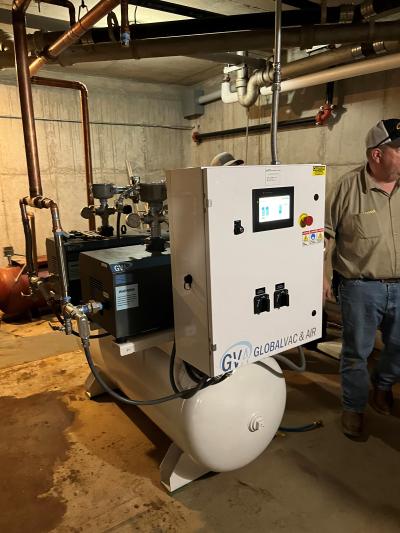
The duplex vacuum pump system was bolted together onsite.
Onsite Vacuum Pump System Testing
GlobalVac & Air tests all the systems it sells before they leave its facility, but conducts additional testing on site once the system is installed. It tests for leaks, makes sure the vacuum level is on target and sees that the entire system is operating smoothly. On-site testing took two to three hours.
“Testing went really smoothly. The facilities team asked a few questions about long-term maintenance and the oil that should be used,” Fleming said. “One of the first things the facilities manager asked me was how long he could expect this system to be in place, because the previous technology had been there for about 15 years. I said, ‘If you maintain the system, change the oil, change the filters, I would say you're good for another 10 to 15 years with this system.’ Brabazon will be the distributor they use to service the unit.”
After the system arrived on site, the installers saw 230V power was required, rather than the originally specified 460V. The company was able to accommodate the change by shipping a new overload sized for the higher current. This adjustment ensured the system operates safely and as intended.
To test the vacuum pump, the distributor’s service tech turned the equipment on and studied the control panel, ensuring the readings were where they were supposed to be. The service tech saw how much vacuum the system supplied and was able to gauge the readings’ accuracy. No on-site adjustments were needed, since the system had been programmed ahead of time.
“On site, the distributor checked the pump, pipes, valves, seals and controls were installed correctly,” Fleming said. “They do performance testing to be sure it can reach its specified ultimate vacuum. Pressure levels are measured and compared to design expectations. The service tech checks for noise, vibration, temperature and stability. The control system was calibrated and it was confirmed it was responding correctly. A GVA manual was placed in a pocket sleeve next to the control panel. Any and all questions are answered during the startup. I recall a question coming up about system maintenance from the facilities manager. We recommend changing the inlet filter every 1,000 hours and changing the gear oil every six months or 2,000 hours. Once the service tech runs through all the necessary tests, he signs off on it.
“There are times when we need to make a call to the product manager and adjust something, change a setting, something doesn't look programmed right, but in this case, we pretty much had it already set.”
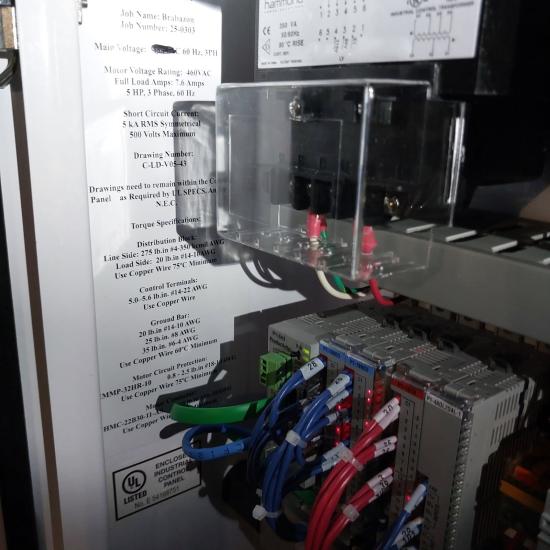
Wiring connecting the control panel with the rest of the vacuum pump system.
Vacuum Pump System Aftercare and New Installations
Since the installation, Fleming has been in touch with the research center several times to go over maintenance information and learn how things are going. The research center is happy with the vacuum pump system’s performance, she said.
The installation could lead to other installations at the university. There are other air compressors and vacuum pump systems on the campus, and it has other research centers. After this successful installation, Fleming thinks her company will be a supplier for future projects.
|
About GlobalVac & Air “GlobalVac & Air has been around for 35 years,” Fleming said. “We’re headquartered in Brockton, MA. We’re a supplier of air and vacuum systems used in applications found in hospitals, labs, universities and industrial plants. We have a team of engineers and product managers who have been in the industry for many years and enjoy excellent relationships with engineering firms, resellers and end users in the Northeast. “We’re looking to expand our footprint, expand our products and go national. I was hired to develop relationships with resellers, end users and engineering firms nationally. I'm not limited to the Midwest, so I get out there and get our name out there. We’re doing that by attending trade shows and doing lots of outreach with our marketing team. We host lunch-and-learns, shake hands and get in front of people. We're growing!” For more information, visit https://globalvacandair.com. |
|
About Brabazon Pump, Compressor & Vacuum Founded in 1978, Brabazon began as a small distributor with a focus on dependable compressed air and vacuum systems. Over the years, its expertise and customer-first approach helped it expand throughout the Midwest. The company operates multiple service centers across Wisconsin, Minnesota, Illinois, Iowa and Missouri, giving customers access to support, fast response times and local expertise when and where it’s needed most. The company’s mission is to provide compressed air systems, pumps and vacuum solutions to enhance efficiency and support the long-term success of its customers. It built its reputation on technical precision, trust and delivering measurable results. For more information, visit https://www.brabazon.com. |
For similar Rough Vac articles, visit https://www.blowervacuumbestpractices.com/technology/rough-vac.
Visit our Webinar Archives to listen to expert presentations on Rough Vac at https://www.blowervacuumbestpractices.com/magazine/webinars.