Follow these tips to ensure reliable results now and for years to come
Leaks in vacuum systems can cause considerable damage to sensitive industrial processes. The vacuum pump’s ability to generate and maintain the desired vacuum level is compromised as the process gas escapes the pump or contaminants – such as air, dust and debris – enter. This leads to accelerated wear and tear of internal components such as seals and gaskets, and the vacuum pump may fail or require more frequent servicing. As a result, energy bills and overall operating costs increase drastically, while output quality suffers. This is why helium leak detectors play a vital role in safeguarding the integrity of equipment.
Not all leaks are obvious. Some may be extremely small or hidden, requiring a systematic approach to detect them. Adopt these seven best practices to conduct accurate and effective leak detection tests. Whether you’re a seasoned professional or a first timer, these guidelines will enhance the efficiency of your leak detection process using the tracer gas helium.
1. Train Employees on Testing and Safety Precautions
Training operators to use a leak detector is essential for collecting accurate test results and increases the longevity of testing equipment. If operators are taught how to use a leak detector, they are less likely to record incorrect data. Training should include studying the instruction manual and participating in training courses.
Additionally, it’s imperative to set and adhere to safety protocols. This includes the use of personal protective equipment (PPE) when working with helium and other potentially hazardous substances. One needs to be careful when handling helium gas as it can act as an asphyxiant in high concentrations. A combination of training and safety guidelines will optimize the performance of leak detectors while maintaining a secure working environment.

Be sure employees are trained on leak detection testing equipment and safety procedures.
2. Create a Stable Testing Environment
To ensure precise results, leak detection tests must be performed in a stable environment with a consistent temperature. Higher temperatures cause helium molecules to expand, leading to lower gas density. This increases the buoyancy and dispersion rate of the gas. At the other extreme, colder temperatures make helium molecules contract, increasing gas density and making the gas move at a slower rate. These changes in the behavior of the tracer gas affect how it moves through or around the test object, impacting the accuracy of the leak detection test. A stable environment ensures the gas behaves consistently, leading to reliable outcomes. Additionally, keeping both the equipment and the testing area clean is crucial. Dust, oil and other particles can interfere with leak detection equipment reliability.
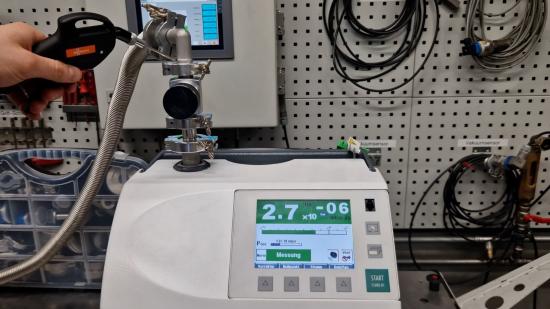
Perform leak tests in a clean environment with a stable temperature.
3. Prepare the Testing Environment
The equipment being tested – a pipeline or container, typically – should be clean and dry, and the area free of gases or substances that might interfere with the accuracy of the leak detection process. Zero the leak detector so that it starts from a clean slate. Without zeroing, the detector might not recognize small leaks. Adjust the sensitivity settings based on the expected leakage rate to minimize false positives.
Select the testing method that suits your vacuum system. A spray test is suitable for components under vacuum. In this test, helium is sprayed onto the equipment’s surface. If there is a leak, the incoming molecules of the tracer gas will be drawn into the leak detector, which measures the leakage rate. For components under pressure, a sniffing test is suitable as it detects escaping gases. Helium is pumped into the test object and a sniffer probe – a tool designed to detect and locate leaks – is guided over it. The sniffer probe functions similarly to a metal detector, but it’s searching for traces of helium. Both tests are easy to perform and deliver accurate results.
Perform tests slowly and don’t move the leak detector when it’s in operation. That could disturb the turbomolecular vacuum pump, causing damage to the equipment or compromising the accuracy of the test.
4. Stay on Top of Repairs
Once a leak has been detected, repair it immediately. Conduct another leak detection test afterwards to ensure the leak has been sealed. Performing regular leak detection tests is crucial for preventative maintenance. Taking a proactive approach ensures the detection methods are aligned with industry standards, contributing to a consistently effective leak detection system.
5. Record Data
Keep detailed records from each leak detection test, including the date, time, location, equipment used and severity of the leak. Having detailed records allows for a comprehensive comparison between the detected leak rate and the acceptable limits for the specific application. By collecting and organizing the data, you can identify trends and form prevention strategies.
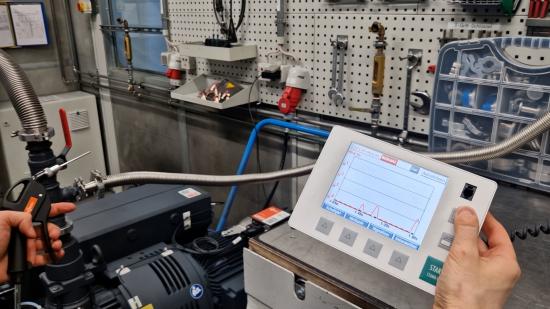
Record the data from your leak detection tests to identify trends.
6. Maintain Testing Equipment
Follow the manufacturer’s maintenance schedule to keep your leak detector in optimal working order. Performing calibrations helps preserve the accuracy of the equipment, as testing carried out during calibrations checks whether or not the detector is still sensitive and responsive to the tracer gas. Adhering to these guidelines will help the leak detector work reliably for years to come.
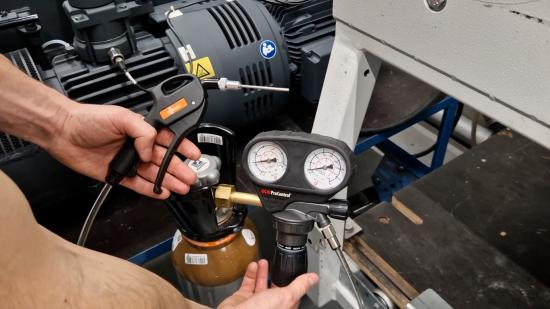
Perform calibrations regularly to preserve the accuracy of leak detection equipment.
7. Dispose of Hazardous Materials Safely
Recycle or dispose of helium gas cylinders in accordance with local regulations. Stay up to date with industry standards governing leak detection and emissions control in order to minimize the release of volatile organic compounds and hazardous air pollutants.
Adopt these seven best practices to guarantee efficient leak detection, ensure the safety of your testing process, maintain test result quality and safeguard your vacuum pumps. Focusing on training, safety protocols and a stable testing environment ensures your equipment delivers accurate results. Keeping careful records, performing regular maintenance and calibrating your leak detector optimizes the process and increases the longevity of your equipment. By following these practices, both beginners and experienced professionals can locate leaks, keep the workplace safe and contribute to a cleaner and safer industrial area.
About the Author
Sinja W. Stentoft is Editor Communications at the Busch Group. During her time at the company, she has gained extensive knowledge of vacuum technology in a wide variety of industries. She holds a bachelor's degree in linguistics and a master's in intercultural communication. Before joining the Busch Group, Sinja worked in the life sciences industry.
About Busch Vacuum Pumps and Systems
Busch Vacuum Pumps and Systems is one of the largest manufacturers of vacuum pumps, blowers and compressors in the world. Its products are at the forefront of vacuum and low-pressure technology. For more information, visit https://www.buschvacuum.com.
For similar articles on Vacuum System Assessments, visit https://www.blowervacuumbestpractices.com/system-assessments/vacuum-systems.
Visit our Webinar Archives to listen to expert presentations on Industrial Vacuum Technology at https://www.blowervacuumbestpractices.com/magazine/webinars.