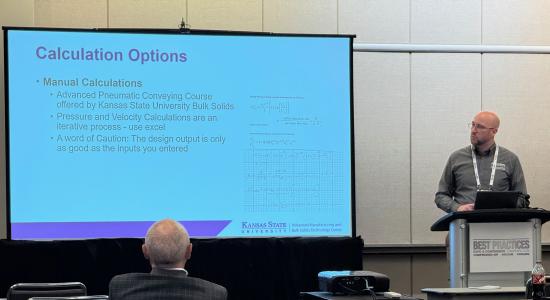
Jonathan McPherson, Director of Advanced Manufacturing and Bulk Solids Technology Center, Kansas State University, led the Pneumatic Conveying Workshop.
The Best Practices 2025 EXPO & Conference contained plenty of sessions for industrial vacuum, blower and aeration blower professionals, including conference tracks, workshops devoted to pneumatic conveying and blower engineering and original equipment manufacturers on the EXPO floor.
Aeration Blowers
A conference track titled “Fundamental System Design, Control and Component Selection” brought efficiency to the forefront of the conversation. Bob Kisler, Sales Manager, Hoffman & Lamson, explained how most open valve (MOV) control can lead to major aeration blower efficiencies. To maintain an aerobic biological process, it’s necessary to maintain the appropriate dissolved oxygen (DO) concentration in the basin. Inadequate DO can result in poor treatment, but excess DO wastes energy without improving treatment. “For most pressure loop controls, the demand of the tank can change. That DO changes depending on the influx happening during the course of the day, week and year,” explained Kisler. Control of the DO concentration is the most cost-effective method of optimizing aeration energy. A properly operating DO and aeration control system can save 25-40% of the energy used by manually controlled systems.
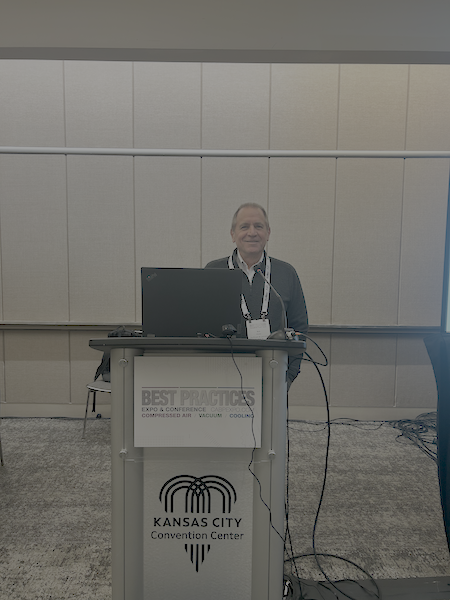
Bob Kisler of Hoffman & Lamson delivered an aeration presentation titled “Most Open Valve Control Drives Major Aeration Blower Efficiencies.”
Attendees learned how to improve energy efficiency and reliability through pump system optimization from Matthew Derner, Senior Manager, Education and Training, Hydraulic Institute. His presentation covered a critical skill set required to analyze and optimize pumping systems by reducing energy and maintenance costs. He reviewed pump system economics, optimization based on lifecycle costs and standardized processes to assess and improve pumping systems.
Industrial Vacuum and Blower Systems
The Pneumatic Conveying Workshop, led by Jonathan McPherson, Director of Advanced Manufacturing and Bulk Solids Technology Center, Kansas State University, offered instruction on pneumatic conveying fundamentals plus an introduction to basic calculations and sizing. McPherson included his own rules for pneumatic conveying. “Convey completely flat or completely vertical,” he said, never at an incline. Also, avoid “back-to-back elbows,” because material needs time to re-accelerate after an elbow turn.
The Blower Engineering Workshop offered five hours of foundational and advanced blower engineering instruction from Julie Gass, P. E., Lead Process Mechanical Engineer, Black & Veatch. “When you talk about running different technologies in parallel, that needs to be considered in design,” Gass said, warning about the possibility of surge. “If a plant says, ‘We want to add a blower but we never plan to operate it in parallel with our existing blower, which is a different technology; we’ll run them at separate times,’ okay, great. But if, after it’s installed, they decide to run them in parallel, that doesn’t necessarily work. It has to be planned for during design.”
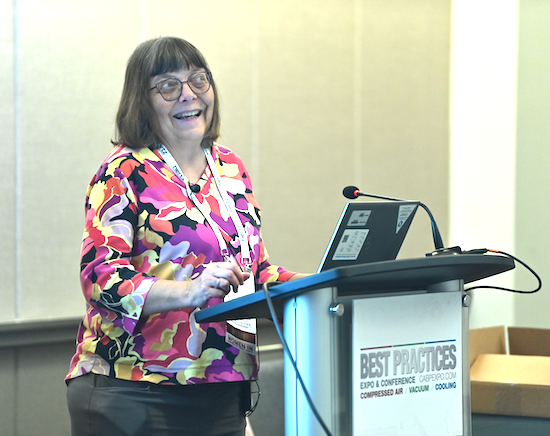
Julie Gass, P. E., Lead Process Mechanical Engineer, Black & Veatch, led the Blower Engineering Workshop.
On the EXPO floor, GlobalVac & Air, part of Flow Control Group, showcased a duplex, dry-claw, lab-based vacuum system that consists of two 5 hp vacuum pumps with a solid-state PLC-driven controller. “It’s called a purge system, which allows the pumps to clean themselves when they’re coming off operation. When one pump is scheduled off, the other pump comes on. The one most recently out of operation will run with fresh air purging through. It cleans off oil and whatever else is in there,” explained Bob Littman, Vice President of Sales. The other vacuum system featured a single pump and tank with a simpler controller (non-PLC), and was designed for a small lab or small vacuum application.

Bob Littman, Elizabeth Fleming, Brett Looney, Jason Cravy, Larry Wilson and Eric Painter (left to right) of GlobalVac & Air.
Kaeser Compressors was ready to talk about the three blower options it carries: lobe blowers, screw blowers and turbo blowers. Lobe blowers are sometimes purchased by OEMs as basic packages and sometimes fully integrated with cabinets, noise insulation and a controller that connects to plant systems. Screw blowers are typically fully integrated into cabinets. Both lobe and screw blowers are popular with wastewater plants, with lobe blowers selected for intermittent use and screw blowers when demand is constant. The third type, turbo blowers, is chosen for larger jobs and offers better isentropic efficiency. Pneumatic conveying is the company’s biggest blower market. A small but growing number of customers purchase blower systems as enclosures. “In a remote location, there might be plenty of space, but delivering blowers in a weather-proof enclosure can save a lot of time in construction and commissioning,” said Michael Camber, Marketing Services Manager.
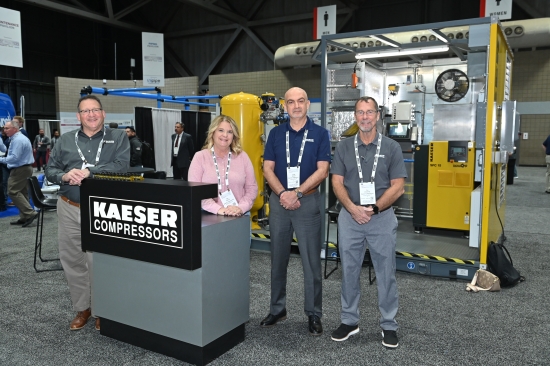
Michael Camber, Kim Pulford, Tareq Saasaa and Tim Pickering (left to right) of Kaeser Compressors.
NAVAC displayed its vacuum product lines, which include UniDrive (single-stage rotary vane vacuum pumps), EcoDrive (two-stage rotary vane vacuum pumps), HelixDrive (dry screw vacuum pumps), BoostDrive (blowers packaged with vacuum pumps) and ShieldDrive (two-stage magnetic coupled drives with no oil leakage). For rough vacuum applications in manufacturing plants, the UniDrive, capable of 29.5“Hg, is typically the best fit, although the company sees the HelixDrive also being a contender. “What’s unique about the HelixDrive is it comes with a special coating on the screws, and it’s designed to handle moisture really well,” said Evan Sawyer, Director of Product – Vacuum Technology. “We’re slowly starting to take this vacuum pump technology and apply it to different industries than it would typically be sold into. We’re starting to drive it into the rough vacuum market to get more exposure to applications that require dry technology but need to handle high moisture content.” These industries include freeze-drying and maple syrup production.
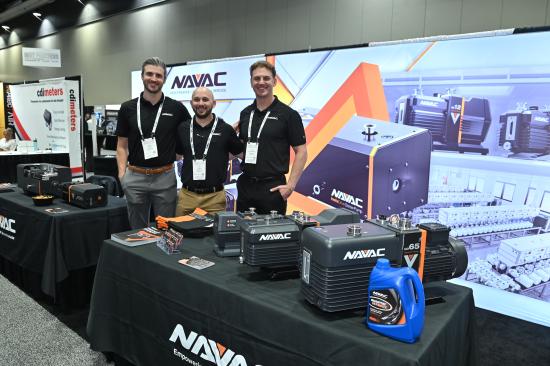
Ryan Billings, Evan Sawyer and Will Schwerdtmann (left to right) of NAVAC.
Turbowin by Easyflex, a manufacturer of oil-free air compressors and blowers, highlighted the supersonic turbo motor used in its products. The motor is frictionless, oil-free and maintenance-free, and offers dual cooling with motor temperature dropping up to 77°F (25°C). Bruce Kwon, Sales Director, showed the products on display. “This is our impeller, which is our core technology that makes our turbo oil-free engine happen.” The company’s WL Series is a line of centrifugal turbo blowers with capabilities ranging from 10 to 600 hp and 5.8 to 17 psi.
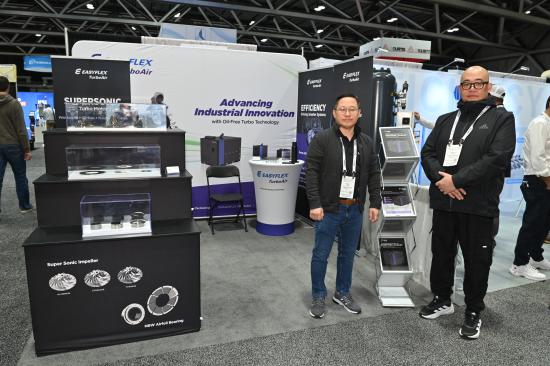
Joseph Chloe and Bruce Kwon (left to right) of Turbowin by Easyflex with the company’s supersonic impellers.
To learn more about the Best Practices 2026 EXPO & Conference in Indianapolis, visit https://cabpexpo.com.
To read the second part of the report showcasing Air Compressor technology, visit https://www.airbestpractices.com/technology/air-compressors/best-practices-2025-expo-conference-show-report.
To read the third part of the report showcasing Chiller & Cooling Technology, visit https://www.coolingbestpractices.com/technology/chillers/best-practices-2025-expo-conference-chiller-cooling-show-report.
To read more Industrial Blower articles, visit https://www.blowervacuumbestpractices.com/technology/industrial-blowers.