
A centralized claw vacuum system helps a pasta manufacturer reduce water use, energy consumption and maintenance while improving process reliability
The pasta manufacturer Wolf Nudeln chose rotary claw vacuum pumps from Busch Vacuum Solutions for its manufacturing processes, with the aim of reducing water consumption, maintenance and energy requirements. State-of-the-art vacuum technology replaced a maintenance-intensive liquid ring solution. The Austrian company now benefits from a reliable, efficient vacuum supply in flour conveying and dough manufacturing – with a significantly reduced failure rate and lower operating costs.
A Family Business with a Focus on Sustainability
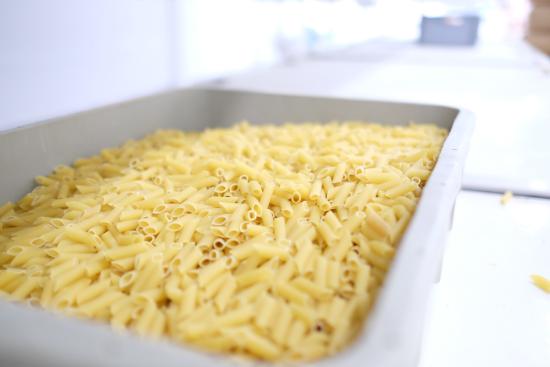
The family business Wolf Nudeln, based in Güssing, Austria, is run by the third generation with Joachim Wolf at the helm. The fourth generation, his two sons, are already lined up as successors. The company dates back to 1890, when the Wolf bakery was founded. In 1956, the bakery started producing pasta, with the first variety being the fine, thin "Goldfaden", which is still popular today as a classic soup topping. The company's 50 employees process around 5,500 tons of pasta annually in a three-shift operation five days a week. Production is completely CO2 neutral, as the company's biogas plant covers all energy requirements and is operated with corn and green cuttings from the company's agricultural production and waste material from in-house poultry farming. The manure comes from an independent egg production facility, which has existed since 1968 and continues to supply the company with all the eggs it needs.
Sustainability is a core building block of the company’s philosophy, with Wolf Nudeln relying on 100% Austrian raw materials such as durum wheat semolina and spelt, as well as fully paper-based packaging. 90% of sales are via the Austrian food retail trade, and catering companies are also supplied directly.
Dough Pot and Flour Suction Systems Transition to Centralized Claw Vacuum Pumps
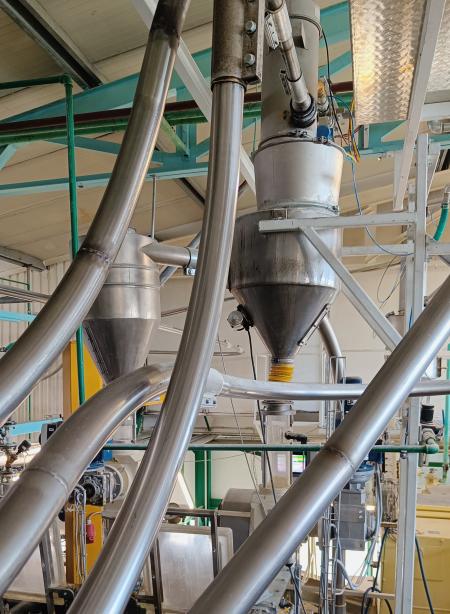
Vacuum pumps are used in two food manufacturing processes. In one process, grains such as spelt, semolina and durum wheat are taken in and processed via seven flour suction lines. In another process, vacuum pumps ensure controlled oxygen reduction during dough production in seven dough pots. The vacuum system also preserves the color of the pasta – a crucial quality factor, especially when processing fresh eggs.
In the past, Wolf Nudeln relied on eight liquid ring vacuum pumps to operate the dough pots. They were associated with comparatively high water consumption, increased humidity and considerable maintenance effort in this application. The vacuum pumps were housed in a technical room with an open basin, which made the system prone to scaling and occasional malfunctions. The vacuum system required regular cleaning and a change of water on the weekend. In addition, water cooling was needed, which significantly increased the use of energy and resources. The company relied on compressed air technology for the flour suction systems. This was often clogged with flour dust, resulting in system failure and requiring complex, time-consuming cleaning.
Joachim Wolf became aware of Busch through an article in an industry trade magazine and contacted the company directly. At the start of 2020, the company began a pilot implementation in the dough pot area with two claw vacuum pumps. During operation, it became apparent that switching to a version of the pumps better suited for humid environments was necessary due to the residual moisture in the application. In addition, two filter systems were added to the two vacuum pumps: one filter prevents water from being sucked in, while a polyester filter retains flour particles and ensures no dust enters the vacuum pump.
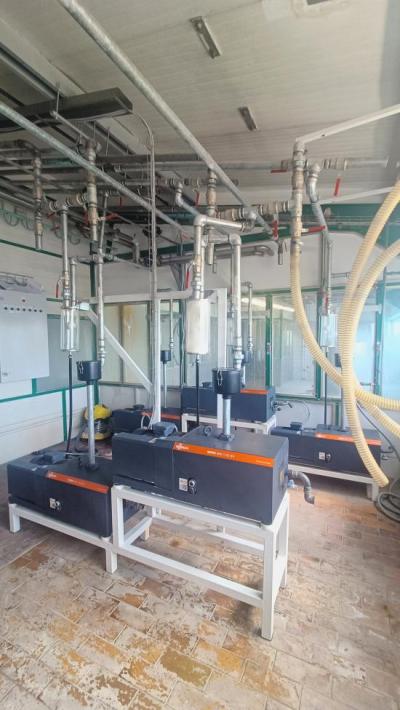
Based on these positive experiences, the solution has been gradually expanded. In May 2024, five additional claw vacuum pumps with an identical configuration were added. Today, the new solution includes seven vacuum pumps placed in a separate technical room, with two used for the flour suction systems and five for extracting oxygen from the dough pots. Thanks to an intermediate vacuum buffer, the lines can now be operated energy-efficiently even in standby mode. The vacuum pumps operate at an ultimate pressure of 70 to 100 mbar, with a power consumption of only 3.5 kWh (50 Hz) per vacuum pump.
Another benefit is that by placing the central system in the separate technical room with active ventilation, the temperature in the room does not exceed 104°F (40°C). The system is low-noise, more hygienic and requires little maintenance. Both filters are easy to clean.
Vacuum-Based Leak Testing in Food ProcessingImagine preparing a bottle of milk for your baby — or a cup of coffee for yourself — and wondering whether the packaging has truly preserved its taste and healthiness. Many products use Modified Atmosphere Packaging (MAP): the air inside is replaced with a protective gas mix to extend shelf life by keeping oxygen out. But even tiny leaks can let oxygen back in, which influences the quality and expiration date of the product in a negative way. Vacuum-based leak testing methods offer clear advantages over traditional techniques, helping maintain quality without slowing down production. Cans of baby formula, once filled and sealed, are expected to protect their contents for a long period of time. That’s an important requirement, especially when even invisible leaks can let in oxygen, slowly degrading the product. For foods like infant milk powder, that’s a risk no one wants to take. And it is not just about baby food. Comparable requirements apply to products like coffee capsules or chip canisters. In all cases, packaging must hold up over time, across transport, and under varying climatic conditions, while reliably preventing oxygen ingress. These products typically rely on protective gas atmospheres to preserve freshness. However, regardless of the packaging concept used, long-term product quality ultimately depends on one factor: a consistently tight and verifiable seal. Vacuum-Based OES and Helium Methods Replace the Water Bath TestThere are several ways to check if packaging is tight. One of the most commonly used methods for leak testing in food packaging is the water bath test, also known as the bubble test. The principle is familiar to anyone who has ever searched for a puncture in a bicycle tire: submerge it in water and watch for bubbles. In food production, the process is similar. Due to its simplicity and low equipment cost, the water bath test is widely used in food production. However, the method has clear limitations. It can be destructive, as tested packages and often their contents must be discarded or at least dried before re-entering production. Manual bubble tests depend strongly on operator attention and subjective interpretation, leading to a higher risk of human error and inconsistent results. Even in automated setups, the test typically provides only a pass/fail result without reliable information on leak size. In addition, detecting small leaks often requires long observation times; tiny leaks generate bubbles only sporadically. Where the bubble test reaches its limits, other methods come into play. One of these vacuum-based methods involves helium as a test gas. Here, a bit of helium is added inside the package. It’s placed in a vacuum chamber, and a detector based on mass spectrometry checks how many helium atoms escape over time. The quantity defines the size of the leak. This method is highly sensitive. Helium atoms are so small they can slip through even the tiniest gaps. That’s why it’s often used to develop and qualify new packaging on a laboratory scale. However, helium testing requires careful handling of the gas and extra steps after testing to verify conditions, especially in high-speed food production, where thousands of packages roll off the line. As a result, helium management and verification can increase both operational effort as well as overall cost. An alternative method is Optical Emission Spectroscopy (OES). Rather than adding any tracer gas, OES analyzes gases already present inside the package, such as nitrogen or carbon dioxide. Under vacuum, escaping gas is briefly excited into a plasma, emitting light with a unique spectral signature. A sensor analyses this light pattern to identify even the smallest leaks, similar to recognizing a substance by its unique color signature. Food Packaging Confidence without CompromiseUnlike traditional water bath tests, both helium and OES methods are non-destructive and deliver objective, reproducible results. OES in particular offers a practical balance: high sensitivity without additional gas handling or sample preparation. Modern OES systems can be positioned at-line, operating with short cycle times and minimal operator intervention. This allows manufacturers to increase testing frequency and ensure consistent packaging integrity without slowing production. Whether it’s milk powder, coffee capsules or chips, tight packaging does more than just protect contents. It preserves shelf life, flavor and consumer trust. Vacuum-based leak detection turns invisible risks into measurable certainty. In vacuum technology, leaks are quantified in units like mbar·l/s. In food packaging, quality is judged differently: how much oxygen enters a package over months or years. Connecting these two worlds is essential. A defined leak rate can be translated into oxygen ingress, helping manufacturers predict whether or not a package will still meet its oxygen limits at the end of its shelf life. Understanding this relationship turns leak testing from a technical exercise into a tool for long-term quality assurance and helps bridge the gap between physics and food safety. 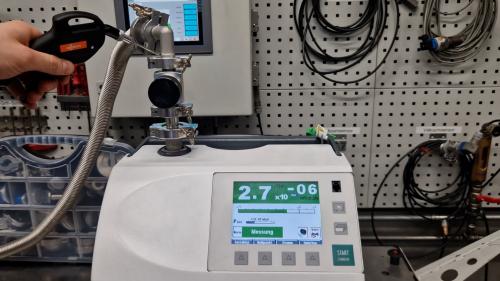 |
Vacuum Pumps Offer Less Maintenance, More Reliability
"I am very satisfied with the vacuum pumps. We have not had any problems since we began using Busch solutions," says Joachim Wolf. Operating costs have fallen, and water consumption, humidity and maintenance have also been drastically reduced. While several vacuum pump failures per year were previously registered, system operation is now stable. At the same time, the current solution allows the system to switch to a replacement pump at any time, without interrupting manufacturing.
Wolf Nudeln is planning to switch to new technology for packaging in the future. A dry rotary vane vacuum pump with a vacuum regulating unit and inlet filter will be used in a tubular bag machine to keep the packaging stable during the filling process. To extend maintenance intervals, reduce operating costs and avoid downtime, the company relies on oil and filter material for the seven solutions.
About the Author

Lisa Glatt is Head of Marketing at Busch Austria, where she leads strategic marketing and communications initiatives. With a passion for storytelling and industrial innovation, she highlights customer success stories demonstrating the value of vacuum and overpressure solutions across diverse industries.
About the Busch Group
The Busch Group is one of the world’s largest manufacturers of vacuum pumps, vacuum systems, blowers, air compressors, chambers and gas abatement systems. Under its umbrella, the group houses two well-known brands: Busch Vacuum Solutions and Pfeiffer Vacuum+Fab Solutions.
The company’s extensive products and services include solutions for vacuum, overpressure and abatement applications in all industries, such as food, semiconductors, analytics, chemicals and plastics. This also includes the design and construction of tailor-made vacuum systems and a worldwide service network. The Busch Group is a family business managed by the Busch family. More than 8,000 employees in 47 countries worldwide work for the group. It’s headquartered in Maulburg, Baden-Württemberg, in the tri-country region of Germany, France and Switzerland. It manufactures in its 20 own production plants in China, the Czech Republic, France, Germany, India, Romania, South Korea, Switzerland, the U.K., the U.S. and Vietnam. It has an annual consolidated revenue of €2 billion.
To read similar articles on the Food Industry, visit https://www.blowervacuumbestpractices.com/industries/food.
Visit our Webinar Archives to listen to expert presentations on Vacuum Pumps at https://www.blowervacuumbestpractices.com/magazine/webinars.
