
How modern blower technologies, controls and lifecycle cost analysis are changing equipment selection for aeration and industrial air systems
In the 1970s, the market for aeration blowers was dominated by two technologies. Small systems generally used two-lobe positive displacement (PD) blowers. Midsized and many large facilities generally used multistage centrifugal blowers. Both types were almost always operated at constant speed. There were exceptions, of course, but the majority of systems fit these generalizations.
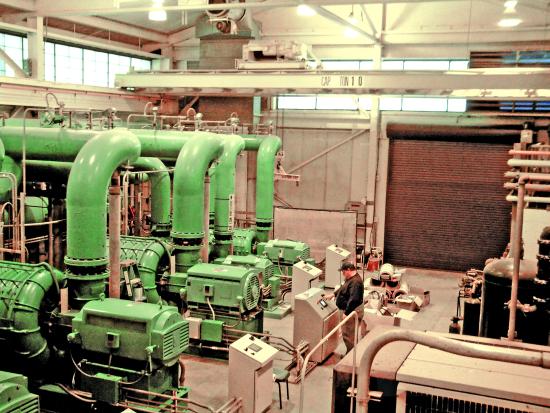
Recent developments in technology have upset the standard practices of the past. Two-lobe PD and multistage centrifugal blowers are still common, but additional choices are available, including:
- Geared single-stage centrifugal blowers
- Turbo blowers (gearless single-stage centrifugal blowers)
- Three-lobe PD blowers
- Screw-type PD blowers
- Variable-speed control for both PD and centrifugal blowers
- Factory-built blower packages
Most of these variations were developed to improve the basic blower efficiency or reduce noise. Other factors, such as simplified installation, also played a role in their adoption.
The fundamental thermodynamics are shared by all blower types, but operational details, physical construction and control requirements vary with the blower type. Understanding these variations is key to optimizing the blower system selection for each application.
Mechanisms of Compression in Blowers
Both new and traditional blowers are divided into two categories based on the mechanism of compression employed.
When the volumetric air flow rate is plotted against discharge pressure, the blower performance can be displayed as a characteristic curve. The intersection of this curve with the system curve – the resistance of the system to flow – identifies the actual operating point of the blower.
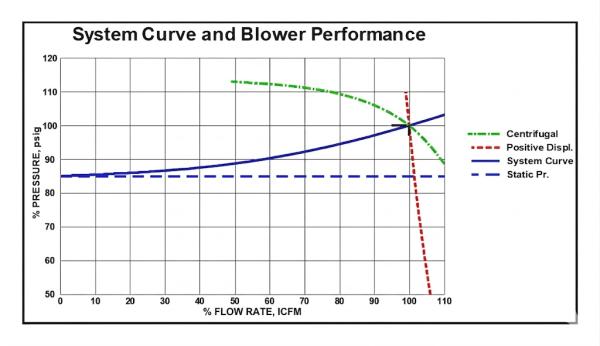
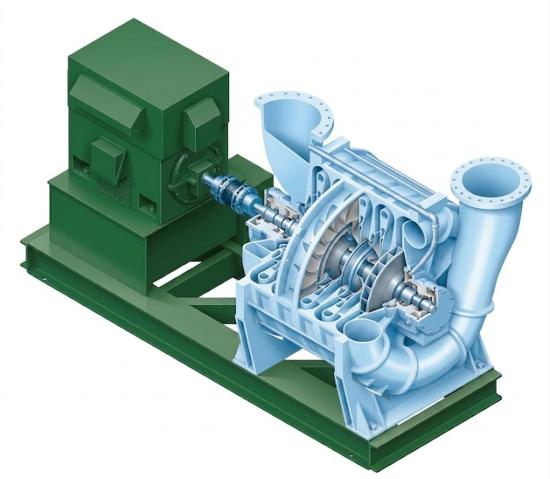
A dynamic – centrifugal – blower relies on a spinning impeller to impart kinetic energy to the gas being compressed (ke = ½ mv2). The impeller consists of a disk with protruding vanes, similar to the impeller of a centrifugal pump. As the gas exits the impeller at its outside diameter, it enters a diffuser section and the velocity decreases. This converts some of the kinetic energy to potential energy. The potential energy is static pressure. At constant speed and constant inlet conditions, the characteristic curve and the variation of discharge pressure and flow rate is fixed.
Because of the low density of gases, the kinetic energy imparted to the gas by the impeller is limited. In order to obtain the required discharge pressure, the multistage blower uses several impellers arranged in series.
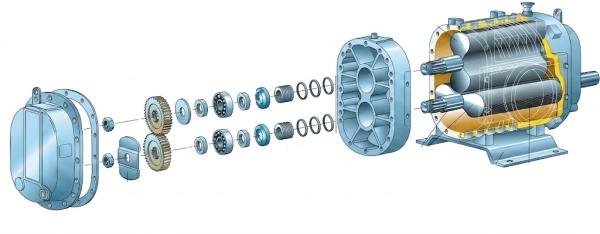
The PD blower performance is based on the geometry of the impellers. Each time the impellers rotate, a fixed volume of the gas is moved from the inlet side to the discharge side of the case. This is the displacement of the blower. As the lobes mesh, the displaced gas is forced out of the blower. The pressure will rise to meet the required system pressure. The resulting characteristic curve is theoretically a vertical line. The deviation from vertical is due to internal leakage, known as slip.
For both types of blowers, power consumption is a function of the pressure ratio and the mass flow rate of the gas being compressed. It’s important to remember for both types of blowers the flow rate is volumetric. Since the density of the gas is influenced by inlet temperature and pressure, the performance of a blower is greatly influenced by inlet conditions.
The Three Types of Bearings Used
Bearings are a potential failure point for blowers and influence blower selection. There are three types of bearings used in supporting blower shafts:
- Journal bearings, with the shaft rotating inside a sleeve and supported by a fluid film
- Anti-friction bearings, with the shaft supported by balls or rollers
- Magnetic bearings, with the shaft levitating in a magnetic field
The journal bearing and anti-friction bearings are most common. Both types are used in both centrifugal and PD blowers. Journal bearings are used primarily in large or high-speed applications. Magnetic bearings are used in large, high-speed turbo blowers.
Bearing friction is low for all three types. The bearing selection is based on mechanical considerations and only has a minor impact on power consumption.
Blower Developments Since the 1970s
A number of blower technologies have been implemented since the 1970s, and the market has been increasingly willing to adopt them. The drive to optimize energy consumption is often the primary incentive for the changes. Decreased noise and more convenient installation also play a part in these developments.
The tri-lobe PD blower was popular in Europe before it was widely accepted in the U.S. market. Although claims of higher efficiency are often made for the tri-lobe, its principal advantage is noise reduction. The higher frequency noise produced by the tri-lobe PD blower is easier to attenuate than the lower frequency produced by two-lobe blowers.
Noise abatement was one of the goals of pre-engineered blower package development, which nearly always includes sound enclosures. These factory-assembled packages normally include inlet and discharge silencers matched to the blower type and characteristics. Controls, instrumentation, blow-off valves, drive systems and other required accessories are usually included to create a complete blower system. The result is reduced footprint, simpler installation and improved operator convenience. These pre-engineered packages are available with many types of blowers, both PD and centrifugal.
Geared single-stage centrifugal blowers were once only applied to large facilities with high flow rates. New manufacturers have entered the field, and geared single-stage units are now available down to 15 horsepower (hp). They offer high efficiency and compact packages.
One of the most popular innovative designs is the gearless single-stage centrifugal blower, commonly called a turbo blower. They operate at extremely high speeds, typically several thousand rpm. An integral variable-frequency drive (VFD) with output frequencies of several hundred Hertz is required to obtain these high speeds. A synchronous motor has the blower’s impeller mounted directly on the motor shaft. The motor employs specialized journal bearings to accommodate the high speeds. Smaller units use ambient air for the fluid film supporting the shaft. Larger units require magnetic bearings to levitate the motor’s shaft.
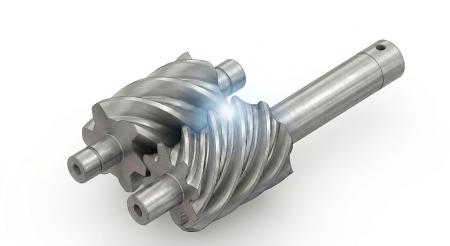
The most significant development for PD blowers is the rotary screw blower. The conventional PD blower uses two identical impellers and induces flow transverse to the blower shafts. Compression takes place externally to the impellers. On the other hand, the rotary screw blower uses a male and a female rotor to move the gas axially. Some compression takes place internally. Although the rotary screw air compressor has been used for many years at higher pressure ratios, it is only relatively recently that rotors were available for the low pressure ratios needed for blower applications. This PD technology exhibits high efficiency across the blower operating range and has excellent turndown.
The Importance of Blower Controls
For both custom-built and pre-engineered packages, the control system can be of equal importance to the blower itself. Energy consumption, equipment life and operator satisfaction are significantly influenced by the control system.
Controls can provide blower health monitoring, protecting the blower from unusual operating conditions. The controls can stop the blower before catastrophic failure occurs. The control system can also optimize energy consumption by matching the flow rate to meet actual process demand. Pre-engineered package systems generally offer control systems combining both functions.
The most significant control development is undoubtedly the use of VFDs to control blower flow rate. Using a VFD to control PD blowers made their use in variable flow applications practical. And, by virtue of the affinity laws, replacing throttling valves or guide vanes with VFDs greatly reduces power consumption for centrifugal blowers.
Applications for PD and Centrifugal Blowers
Blower applications can be distinguished by inlet and discharge conditions:
- Constant or variable flow rate
- Constant or variable discharge pressure
- Wide or narrow range of inlet conditions
The selection of the optimum blower for each application must consider each of these parameters.
In the past, variable discharge pressure generally mandated the use of PD blowers, since they inherently adjusted to discharge pressure deviations. On the other hand, variable flow applications tended to use centrifugal blowers, since the flow rate could be economically controlled by throttling or guide vanes.
This is no longer the case. The combination of blower technology and control capabilities allows any type of blower to be applied to virtually any application. This opens opportunities for optimization, but also complicates the system designer’s task.
The best method for comparing the options is to begin with an evaluation of the lifecycle cost:
LCC=Equip+Inst+Energy+Maint
Where:
LCC = Total lifecycle cost
Equip = Initial cost of the blower system, including accessories
Inst = Cost of installing the blower system, including mechanical and electrical installation
Energy = The total cost of energy, calculated as the annual energy cost x the expected service life
Maintenance = The anticipated cost of preventive and corrective maintenance
The option with the lowest lifecycle cost is not always the best selection. Other factors to consider in making the final selection include experience with the supplier, robustness of the system and operator preference.
Summary
New developments in blower and control design have expanded the options available to designers. The two basic categories – PD and centrifugal – remain the same. The original designs are still valid and may still be the best choice for many applications. However, high efficiency, reduced noise or process flexibility may make the new configurations a better choice for other applications.
About the Author
Tom Jenkins has over forty years’ experience in blowers and blower applications. As an inventor and entrepreneur, he has pioneered many innovations in aeration and blower control. He is a former Adjunct Professor at the University of Wisconsin, Madison, and is a Fellow of the Water Environment Federation. Tom is the current Chair of the ASME PTC 13 Committee. For more information, visit https://www.jentechinc.com.
To read similar articles on Aeration Blowers, visit https://www.blowervacuumbestpractices.com/technology/aeration-blowers.
Visit our Webinar Archives to listen to expert presentations on Aeration Blowers at https://www.blowervacuumbestpractices.com/magazine/webinars.
