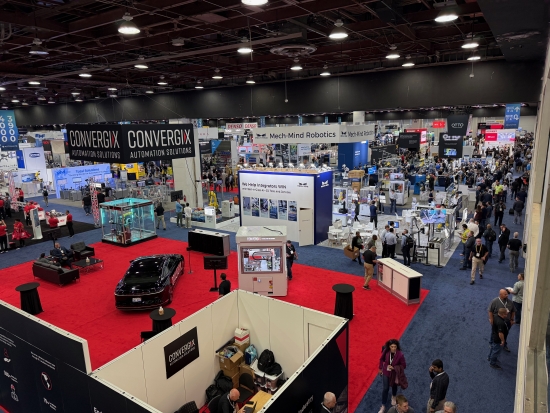
Many of the booths at Automate 2025 featured pick-and-place vacuum generation applications using compressed air.
Automate 2025, held in Detroit, MI, from May 12-15, showed attendees how to make their industrial plants more efficient with robotics. Throughout the conference, robotic arms shuttled packages, burgers and even macarons with speed and accuracy. Driving this new technology was a complex network of pneumatic cylinders and pick-and-place automation powered by pneumatic vacuum generation. Innovation makes these proven technologies more efficient than ever.
The show drew over 800 exhibitors and spanned 320,000 square feet. Over 200 speakers led conference sessions.
Vacuum Generators
Vacuum generators – also called Venturi vacuums or vacuum ejectors – produce suction using the Venturi effect: Compressed air velocity increases as it flows through a constricted section of pipe, then slows as the pipe expands. This produces a low pressure area, creating a vacuum. This vacuum is used in pick-and-place applications with no moving parts.
Schmalz had an impressive display showing its mGrip Finger Gripper, a food-safe gripper it acquired from Soft Robots last year. The company is moving into direct food handling to complement its other vacuum generator-based packaged food grippers. Intended for protein foods, the gripper uses both vacuum generation and silicone grippers to pick up food. Schmalz added the vacuum generator to the middle of the gripper after it purchased the technology. The product is fully enclosed, so air from the system never directly touches the food. “We integrate a lot of air savings into our vacuum generator systems, which give the best bang-for-your-buck in non-porous applications,” said Mike King, Applications Engineering Manager. “We have digital air savings functions in most of our compact ejector lines. Once the system reaches vacuum, a controller on the vacuum generator shuts off compressed air. You're not using compressed air while you're picking up the product. Also, non-return valves are built in to help prevent leakage through the system. Once the vacuum leaks a certain amount, the vacuum generator kicks on the valve, the vacuum rises to the safe handling level, and compressed air shuts off again.”
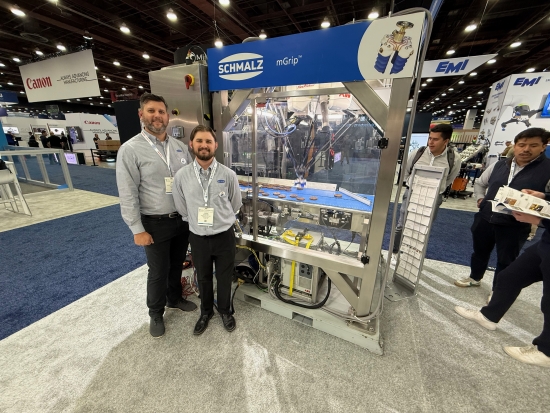
Mike King and Avery Fisk (left to right) of Schmalz, with the company’s newly acquired food gripper.
SMC is focused on making its vacuum generators as efficient as possible, so plants can save on compressed air use and energy consumption while reducing emissions. Its current nozzle designs reduce compressed air use 30-40% over previous generations. It sees many plants switching from older vacuum generators to newer, more efficient models. “Vacuum generators are efficient because you can put them point-of-use. It comes down to the kind of application,” said Jesse DeSanto, National Product Manager. “We sell primarily vacuum generators and see our vacuum segment growing. The big thing is the electrical consumption. Our valves use 0.1 watt of power, so they're almost insignificant from an electrical standpoint. Our products are so light and compact, you can put them at the point-of-use. If you're creating a robot where payload is crucial, you have to look at that.”
Piab held a news conference during Automate to unveil its piCLASSIC Neo, the newest version of its vacuum generator. Intended for the packaging, electronics and automotive industries, the pump comes in two versions with room for up to six COAX ejectors. Each ejector (or cartridge) can represent a different flow and vacuum level. Depending on the porousness of the material handled, plants can decide if they need higher or lower flow. “With our previous generation, you could only have two cartridges per module. Now, you can have three because we reduced the size of the cartridge but maintained the same footprint,” said Madeleine Sheikh, Senior Product Manager. “It's much easier to do maintenance on this version, and because you're able to have more cartridges within the same footprint, you can have more flow because you're able to add three vacuums instead of two. The new cartridges are more efficient, requiring less compressed air to generate the vacuum.”
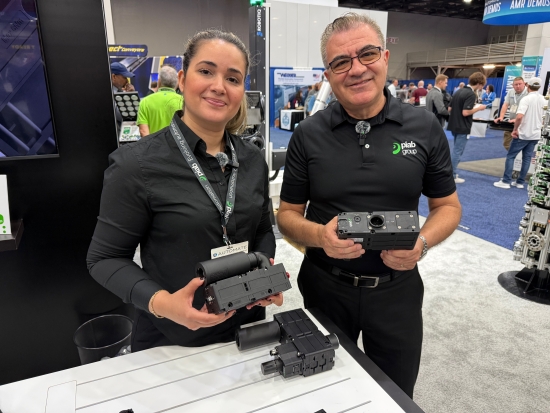
Madeleine Sheikh and Jaime Bohorquez (left to right) of Piab with versions of the company’s new vacuum generator.
Festo displayed its newly released VTUX valve terminal. Sensors built into the terminal’s PCB shut down vacuum generators when not needed and maintain the vacuum level already in use. Operators set their threshold levels and the terminal turns valves on and off as needed, saving both energy and air. “Depending on the application, more than 30% of the air can be saved when using the vacuum,” said Daniella Gonzalez, Product Marketing Manager. “For the next generation product, having all of your controls and pneumatics integrated makes a big difference. The footprint and weight matter. A lot of times, the vacuum has to be mounted where it’s needed. You see that in end-of-arm tools. With this solution, you have a compact solution that eliminates a lot of the footprint.”
SDC (Stephen Douglas Corporation) specializes in the custom creation of factory automation machinery, especially assembly and inspection equipment. It often works with the automotive, medical and solar industries. Across the board, it sees plants concerned with optimizing compressed air use. Writing software to control when vacuum generator systems start and stop is one way to save energy. “A lot of our work is in programming our machines,” Dan Belliveau, Project Director, said. “If you're going to use a vacuum system, programming determines how the system reacts to machine faults. Instead of just sitting there sucking vacuum and using compressed air, we add a staging area where you can shut the vacuum off and not continue to run the compressed air. You can also use energy-efficient valves. There are lots of ways to approach it, but it mostly means limiting compressed air.”
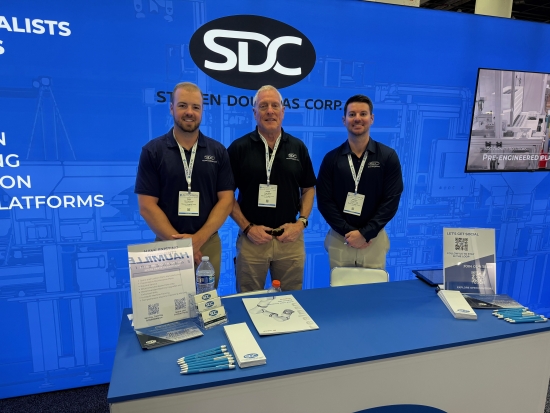
Dan Belliveau, Greg Merrill and Brady Foley (left to right) of SDC.
Machine Concepts builds custom vacuum clamping and pick-and-place solutions for robotic arms and other industrial systems. The companies it supplies demand lower energy consumption, especially in Europe, where energy costs are higher. Much of its work uses closed vacuum systems with automated shutoffs to save energy. Adam Allansson, Sales, praised the intelligent systems controlling these solutions. “It's telling engineers how many kilowatts they’re using, how many amps they’re using. If you’re a good engineer, you know how to reprogram the system and make it better,” he said.
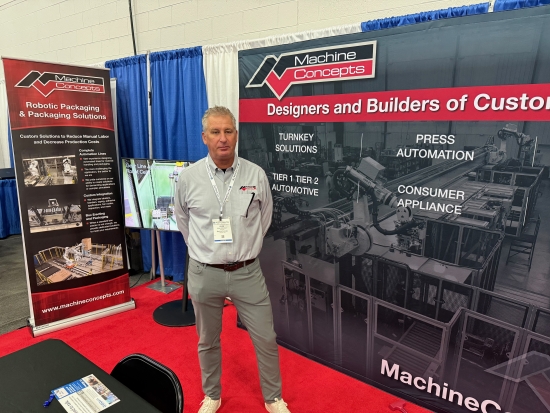
Adam Allansson of Machine Concepts.
VacMotion was at Automate to explain the benefits of its vacuum generators. Vice President Jeff VanEtta highlighted the company’s DSV line, which can range from 0.5 to 80 scfm of compressed air consumption. He showed one model that used 1.8 scfm of compressed air and generated 2.55 scfm of vacuum. It includes one inlet port, a vacuum generator port and a second port for blowoff air to reverse the suction. It’s able to cycle 25 times per second, between vacuum and blowoff. “A lot of times in the vacuum world, when you're picking something, if you've got a really good vacuum hold, releasing the part is a challenge. So that's why they do the blowoff,” he said. “If you're picking up parts off a conveyor and you want to put them in a box, you want to be able to release them before bringing the robot arm back. Having that blowoff helps.” An included silencer keeps the vacuum generator’s noise level down. The company is targeting the packaged food industry.
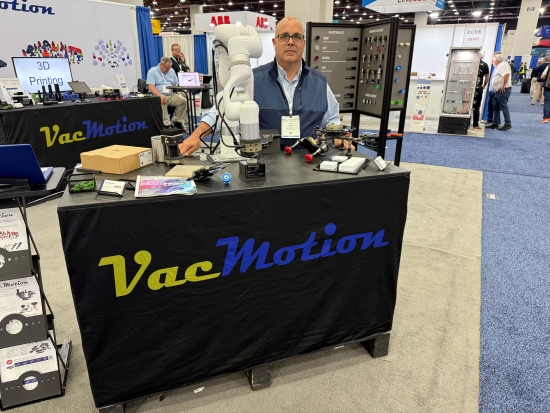
Jeff VanEtta of VacMotion.
Vacuum Pumps and Other Technologies
Becker Pumps was on hand promoting dry rotary vane vacuum pumps and side-channel blowers for the pick-and-place market, with dry rotary vane pumps better suited to lighter materials and side-channel blowers to heavier uses. According to Lars Heckersbruch, Business Development Manager, customers like the low noise level of vacuum solutions. Maintenance is simple, with maintenance for the company’s popular VT line taking only 10-15 minutes. Many of the booth’s visitors asked about variable frequency drives. “That's a big trend,” Heckersbruch said. “We have options to retrofit our pumps or, of course, we can offer a new system. We do a lot of replacement business. Based on the application, the energy savings can be significant. In some cases, we're talking about 70-80% compared to a standard pump.”
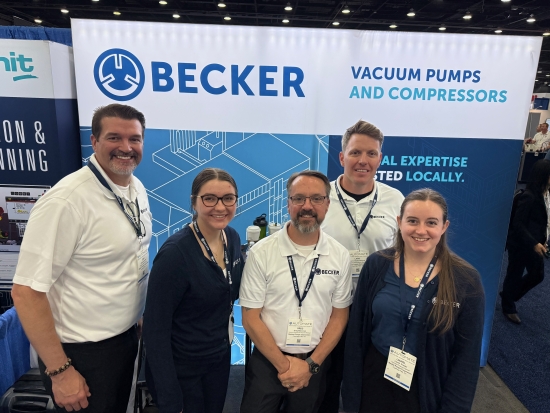
Josh Lancaster, McKenzie Flick, Greg Marciniak, Lars Heckersbruch and Laurel Praeter (left to right) of Becker.
This was Fluid-Aire Dynamic’s third year at Automate, and as the only piping supplier on the show floor (Unipipe has the same owners), it received a lot of attention from companies interested in saving money on their compressed air or nitrogen generation systems. “We've had a lot of success with nitrogen during the last 12 months,” said Rob Yarhmarkt, Sales Engineer. “Nitrogen systems require a compressed air system to go along with them, so we can explain the ROI of getting away from liquid nitrogen and bulk tank storage, then show how they can tie into their existing compressed air system or we can provide them with a compressed air system. At that point, they own their nitrogen and it's all in-house. Then, they don't have to worry about deliveries and rentals and all of the extra fees that go with liquid nitrogen.”
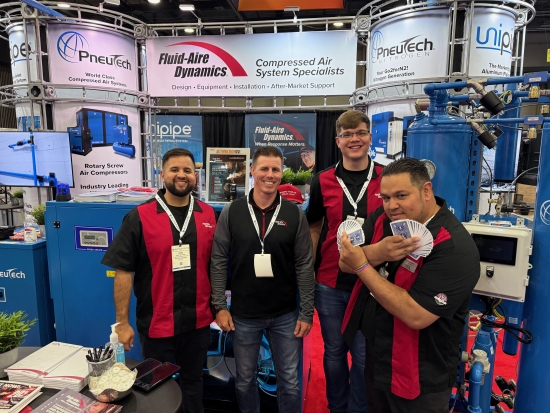
Adam Alvarado, Rob Yarhmarkt, Dylan Work and Plaz Garcia of Fluid-Aire Dynamics.
Pneumatics
Companies looking to lower compressed air use in their pneumatic systems should head to SMC’s online ETech configurator to specify components and get customized advice, said Jesse DeSanto, National Product Manager. Engineers can select components based on the product series, see them in 3D models and download SOLIDWORKS IGES files. “We can even consult with customers to say, ‘Do these tubing lines need to be this long or this big?’ A lot of systems are oversized for what the application does. Even without sitting down with customers, we can see what they want and reduce the amount of compressed air they use.”
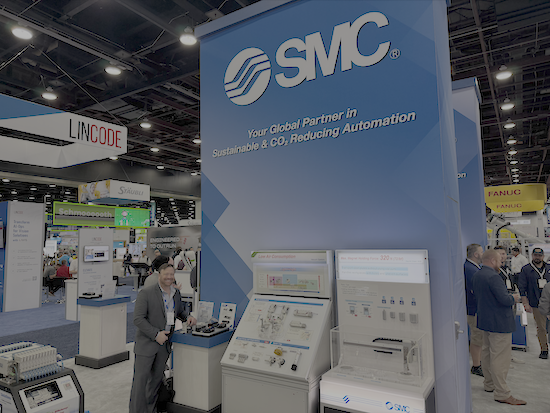
Jesse DeSanto of SMC.
Festo also emphasized a software solution for reducing compressed air use in pneumatic systems. Using its Pneumatic Simulation tool, engineers can input application parameters and get three different options for specifying a system: exact, economical and performance. It also shows tradeoffs in performance. “Designers can see the analysis of what it's recommending,” said Darren O’Driscoll, Product Manager. “At the end of the day, if you need to produce a certain force, if you need a certain area and you need a certain volume of air, you can't do much about that. But if you're looking for a more economical approach, at lower air consumption your positioning time might be slightly longer than you want.”
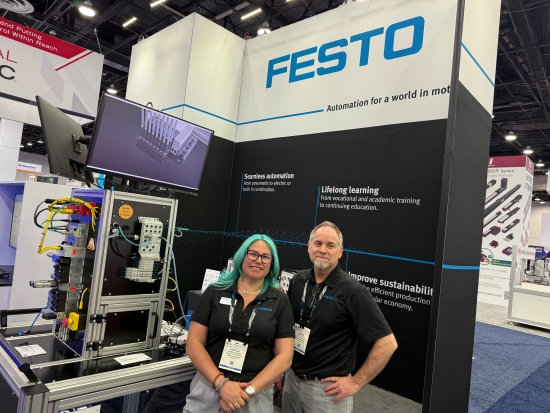
Daniella Gonzalez and Darren O’Driscoll (left to right) of Festo.
In the Automotive industry, pneumatics power the actuators and slides behind clamping systems, noted William Pizzimenti, Senior Account Manager, Fori Automation (part of Lincoln Electric), and that’s been true for decades. Electric clamps go for double the price and so the large facilities Fori works with – including Caterpillar, John Deere, Ford, GM, Chrysler, Nissan and Hyundai – are sticking with the massive compressed air systems they have in place. “You go into any major automotive facility in metropolitan Detroit, each automotive plant is made up of three different centers: body shop, paint shop and general assembly. I've spent quite a bit of time in body shops and assembly shops, and these days those shops are almost a million square feet each. You're talking about a thousand workstations. There are a lot of pneumatic tools. Actuators, clamps, a lot of safety devices are all run off compressed air these days,” Pizzimenti said. “In two years of quoting quite a bit of automation – a couple billion dollars’ worth – we’ve only had one small supplier ask us if we could go to electric.”
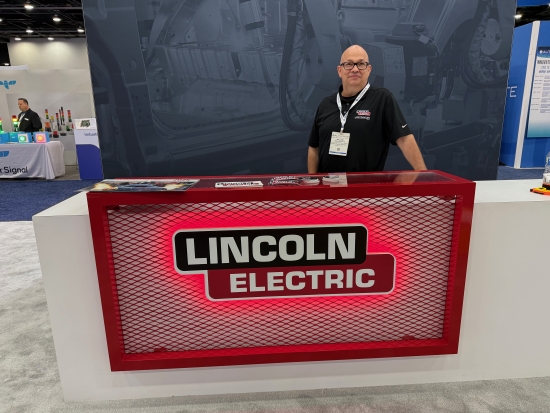
William Pizzimenti of Fori Automation/Lincoln Electric.
Parker Hannifin had safety in mind, as its booth included information on its P33 family of safety exhaust valves, which rapidly exhaust compressed air should a fault condition occur. “We're concerned about exhaust time. Because some environments don't want exhaust in the air, we've made a new safety valve. It's the only one on the market,” explained Linda Caron, Global Product Manager, Parker Hannifin. “We're selling these into control cabinets where people will hard pipe away the exhaust air, and they're using these in freezers where the controls are heated, in dirty environments and even super-clean environments like a food plant where they don't want contamination. This filters to 40 microns. We're not trying to pull big particles out of the compressed air with this. We don't use filters because they're prone to plugging and this is a safety product.”
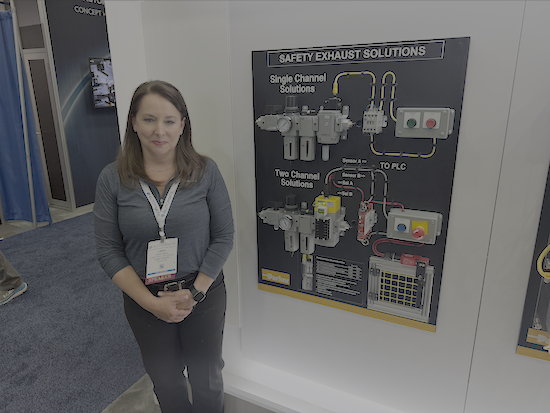
Linda Caron of Parker Hannifin.
Automate will return in 2026, taking place in Chicago, IL, from June 22-25.
To read similar Vacuum Generation Technology articles, visit https://www.blowervacuumbestpractices.com/technology/vac-generation.
Visit our Webinar Archives to listen to expert presentations on Vacuum Systems at https://www.blowervacuumbestpractices.com/magazine/webinars.