
In 2019, the City of East Peoria, IL, began a comprehensive modernization of its wastewater infrastructure, including a $68 million upgrade covering two operating facilities, Wastewater Treatment Plant No. 1 and Wastewater Treatment Plant No. 3. The project addressed aging equipment, regulatory pressure and the need for improved process control.
Jeremiah Boyd, Wastewater Foreman, City of East Peoria, said the project was driven by both mechanical realities and regulatory requirements. “Our infrastructure was basically 20 years past the end of its service life, and, at the same time, our permit renewal was coming up,” Boyd said. “The EPA stepped in and said, ‘Look, you guys need to invest in your system. You need to upgrade your infrastructure.’ With that came new nutrient removal requirements.”
Antiquated Wastewater Treatment System Needs Updating
The two facilities operate extended aeration treatment processes with different design capacities. Plant No. 1 has a design average capacity of 5.43 million gallons per day (MGD) with a maximum of 10.86 MGD. Plant No. 3 operates at a 1.2 MGD design average and 2.4 MGD maximum. At the start of the project, both plants relied on aging equipment with limited automation or process visibility.
“Plant one and plant three were antiquated systems,” Boyd said. “We had no visibility on SCADA, and we had no control over anything. Most everything was either on a soft start or across-the-line start with no VFDs.” Blowers ran continuously at full speed, and operators controlled airflow by manually adjusting valves. “A soft start will always go to 60 Hz and full speed. You get a slow ramp-up and ramp-down, but you can’t adjust speed like you can with a VFD. We were basically running the blowers at 100% all the time.”
The lack of automation extended beyond airflow control. Alarm notifications relied on a simple telephone dialer system rather than modern monitoring. “If something faulted, it would just call and say ‘channel one fault,’” Boyd said. “You had to come in and figure out what the issue actually was.”
At the same time, the plants struggled to meet environmental requirements. The U.S. Environmental Protection Agency pushed for improved nutrient removal performance, particularly phosphorus.
“We were having issues with effluent solids, and nutrient removal was the big one,” Boyd said. “At plant one, they wanted us to treat better for phosphorus removal. Part of the issue was we couldn’t control our dissolved oxygen (DO). It was always way too high.” Without precise aeration control, the biological process couldn’t consistently maintain the DO levels required for effective biological phosphorus removal.
Introducing Three Anaerobic Treatment Zones
To address the regulatory pressure and aging infrastructure, the city launched a complete modernization program, including major process modifications. One of the most significant changes was the introduction of anaerobic treatment zones.
“We added three anaerobic basins ahead of the aeration basins,” Boyd said. “That was a big part of being able to treat phosphorus effectively.”
Additional equipment upgrades supported the new treatment strategy. The plants installed a high-pressure coarse bubble mixing system powered by two air compressors. The system provides mixing and oxygen transfer to support biological nutrient removal.
The project also introduced modern instrumentation and control systems. New sensors monitor DO and communicate with plant automation systems through a supervisory control and data acquisition platform.
The timing of the investment proved beneficial for the city. “We started the project before COVID, so the cost of everything wasn’t as crazy as it is now,” he said. “We were able to secure EPA financing with loan forgiveness and low interest rates. From a taxpayer standpoint, we did it at the right time.”
Rebuilding Wastewater Treatment Plant No. 3 from the Ground Up
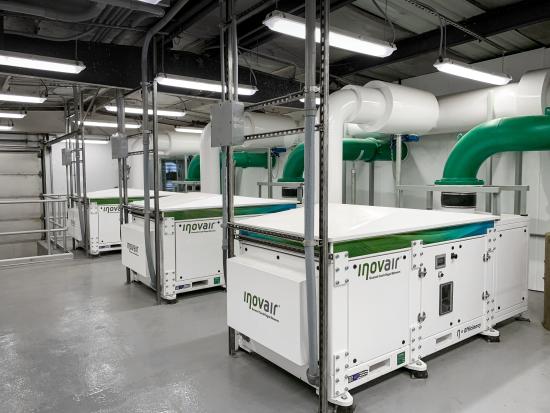
Engineering for the modernization project was led by Farnsworth Group. The firm had prior experience specifying industrial blowers in similar wastewater applications. “They had used Inovair on a couple of other plants and had good luck with them,” Boyd said. “They put them in the spec and recommended them to us.” Gasvoda was the local distributor. The plant’s operators immediately recognized the potential advantages of the blower design.
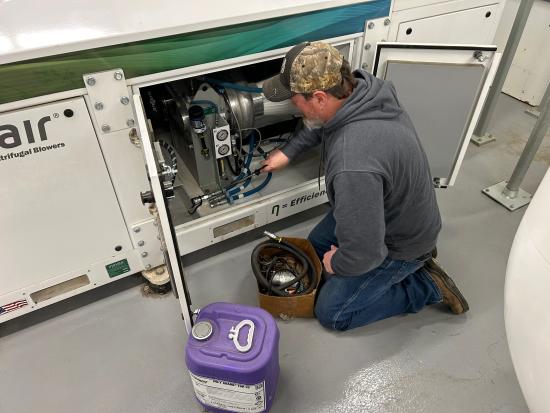
“We looked at the information on them, and right away we could see the simplicity,” Boyd said. “From an operator standpoint, I liked the idea of being able to get my preventive maintenance done quickly and not have a machine I have to babysit all the time. We needed equipment simple to operate and maintain.”
The first blower installation occurred at Wastewater Treatment Plant No. 3. The plant was essentially rebuilt from the ground up during the modernization project. “We added two automatic bar screens, new pumps on VFDs and a brand new grit removal system,” Boyd said. “We also installed a HUBER dewatering screw press so we could process sludge directly at that plant instead of hauling it to Plant 1.”
The blower installation included three 100 hp geared centrifugal blowers. Plant No. 3 reached operational completion in January 2022. The blower system was integrated with DO sensors from YSI and controlled through a master control panel (MCP) communicating with the plant SCADA system.
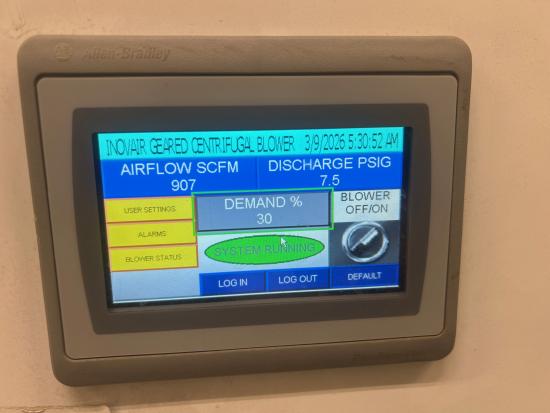
“I’ve got YSI process sensors out in the plant measuring DO, and I set my target on the MCP,” Boyd said. “The sensor feeds back to the control panel and the blower ramps up or down to maintain the dissolved oxygen level. We’re usually within two- or three-tenths of our target at all times. That allows us to maintain consistent treatment.”
Adding a Fail-Safe Mode to Guarantee Air Delivery
The system is designed with a fail-safe mode to maintain aeration if instrumentation fails. “If we lose communication with the DO probe, the blower automatically goes to 100%,” Boyd said. “It guarantees we have enough air going into the basin.”
Ken Jones, CEO, Inovair, said the approach reflects typical customer preferences. “You can change the default behavior, but many operators prefer to have the blower go to full output if communication is lost,” he said. “It ensures the process always has plenty of air.”
“Most days, the blower is running at exactly the same output when we come in,” Boyd said. “If I walk in and see it at 100%, I know something changed. Usually, the DO probe needs cleaning.”
The installation reduced energy consumption across the treatment system. “Our finance director and I looked at the numbers, and we’re seeing about 18 to 21% energy savings across the plants, depending on the month,” Boyd said.
Those results align with typical performance improvements when modern blower technology replaces older equipment. “Where older multi-stage blowers are running without VFD control, it’s common to see around 25% energy savings when switching to more efficient designs,” Jones said.
Second Phase: Additional Blowers at Plant No. 1
After the successful deployment at Plant No. 3, the city installed additional blowers at Plant No. 1 roughly two years later as part of the final construction phase. The larger plant required high-capacity aeration equipment for the main basins. Four 100 hp geared centrifugal blowers supply air to elevated sludge storage tanks with a combined capacity approaching 800,000 gallons. The largest tank holds approximately 513,000 gallons, and two additional tanks hold 168,000 gallons each.
“These blowers provide mixing in the sludge holding tanks,” Boyd said. “We repurposed an old anaerobic digester and installed diffusers at the bottom. The bottom of some tanks is actually lower than the others. When a tank is empty, the air wants to go there because it’s the path of least resistance.”
Variable speed control allows operators to adjust blower output and maintain proper mixing in whichever tank is active. Typical operating pressures are around 8 to 9 psi (0.6 barg), but can rise above 10 psi (0.7 barg) when all tanks are full.
Meeting Future EPA Phosphorus Limits
With both plants modernized, the East Peoria wastewater system now operates with full SCADA integration and automated aeration control. The improvements have dramatically simplified plant operations.
“Ease of maintenance and control are the biggest benefits,” Boyd said. “If I get an alarm, I can open my iPad and see exactly what the plant is doing and what the blowers are doing.”
The upgrades also positioned the city to meet upcoming regulatory requirements. Current permits require a monthly average phosphorus concentration of 1 milligram per liter in effluent. Beginning in 2029, the limit will tighten to 0.5 milligrams per liter. The plant is already meeting the future standard.
“Our deadline is 2029, but we’re already there,” Boyd said. “The anaerobic zones, the ability to control DO and the mixing from the blowers all help us treat phosphorus effectively.”
“It’s a great example of what happens when a knowledgeable operator gets equipment that’s simple and reliable,” Jones said. “You end up with a plant that runs efficiently and meets its environmental goals.”
For more information, visit https://inovairblowers.com.
To read similar articles on Wastewater Treatment Plants, visit
https://www.blowervacuumbestpractices.com/industries/wastewater.
Visit our Webinar Archives to listen to expert presentations on Aeration Blower Systems at https://www.blowervacuumbestpractices.com/magazine/webinars.
